Last updated . Written for winter 2026–27 (November to March) from Mountaineering Scotland and Traffic Scotland guidance and Met Office climate averages. Tour links go to GetYourGuide; we may earn a commission at no extra cost to you.
Glencoe in winter is wet more often than it is snowy, and it gets dark early. The most important thing you can pack is a proper waterproof jacket with waterproof trousers to match. Close behind come warm layers that still insulate when damp, waterproof boots with real grip, and a head torch. This list is for Glencoe from November to March; for summer midges and a general Highlands list, see our year-round Highlands packing list.
- A waterproof jacket with a hood and taped seams, plus waterproof over-trousers.
- Layers instead of one big coat: a base layer, a fleece and an insulated jacket.
- Waterproof walking boots with a deep-lugged sole, and microspikes for icy paths.
- A head torch and a charged power bank. In mid-December you get under seven hours of daylight.
- A spare hat and a second pair of gloves. Wet gloves stop working, and winter kit lists treat a spare pair as essential.
Not driving? The calendar above is for the From Edinburgh: Loch Ness, Glencoe & Scottish Highlands Tour (from $69, 4.7/5 from more than 12,000 reviews on GetYourGuide), a coach day that stops in Glencoe and on Rannoch Moor. You won't need the day pack or car kit on a tour, but the waterproofs, warm layers and shoes with grip still matter at every photo stop.
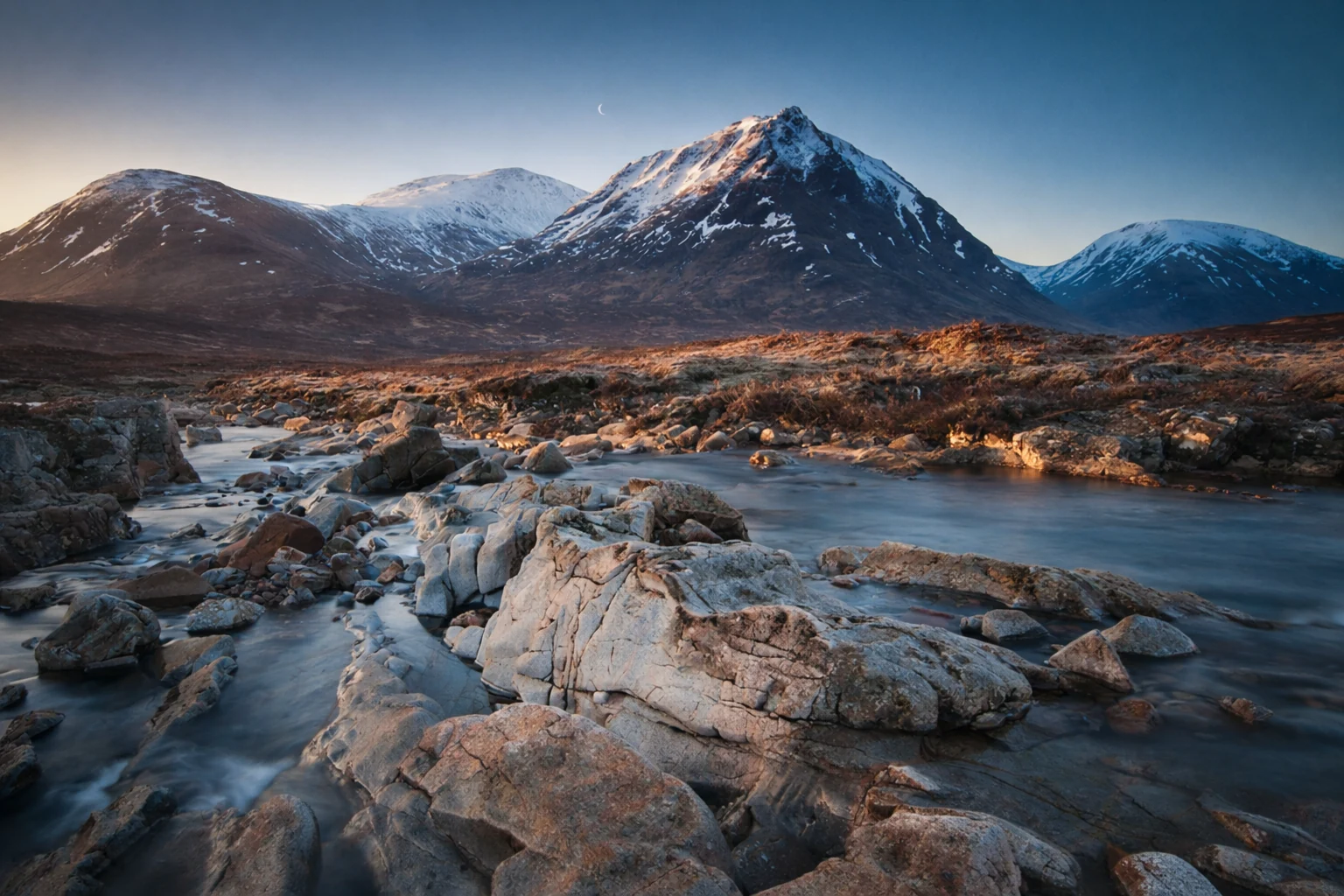
What the Weather Means for Your Kit
Glencoe has no long-running Met Office climate station of its own. The two closest are Tulloch Bridge, inland at 237 m, and Dunstaffnage, on the coast near Oban, and between them they show the range you'll meet on the floor of the glen.
| Month | Tulloch Bridge average high / low (°C) | Dunstaffnage average high / low (°C) | Average rainfall, Tulloch Bridge (mm) |
|---|---|---|---|
| November | 8.0 / 2.2 | 10.0 / 5.0 | 203 |
| December | 5.9 / −0.5 | 8.0 / 2.9 | 223 |
| January | 5.7 / −0.1 | 7.5 / 2.7 | 250 |
| February | 6.0 / −0.2 | 7.8 / 2.6 | 187 |
| March | 7.6 / 0.9 | 9.3 / 3.4 | 154 |
Met Office 1991–2020 averages.
- Rain is the main problem. Tulloch Bridge averages 19.7 days with 1 mm of rain or more in November and 19.1 in December, and coastal Dunstaffnage has a similar 19–20 rainy days a month. You will get rained on, so pack for it.
- Temperatures sit around freezing. That is the worst range for comfort: wet snow, sleet and black ice, not dry powder. Wind makes it feel colder still. The Met Office notes that the feels-like temperature can be 3 or 4 degrees below the actual maximum, and the high tops are colder again.
- Daylight is short. On the shortest day (21 December 2026) Fort William gets about 6 hours 45 minutes of daylight, and sunset is as early as 3:39pm in mid-December. Plan your walks around the middle of the day and carry a torch anyway.
- Snow can't be relied on. The Scottish Avalanche Information Service usually starts its full daily forecasts, Glencoe included, in mid-December. Snow in November is possible, but you can't plan around it.
The Layering System
Wear several thin layers that you can add or take off as you warm up and cool down. One heavy coat can't do that.
- Base layer (next to skin): merino wool or a synthetic fabric, never cotton. Merino stays warm when damp and doesn't smell after days of wear; synthetic dries faster and costs less. Either works.
- Mid layer: a fleece or a light synthetic-insulated top. This is the layer you take off on the climb and put back on at the top.
- Insulated jacket: for a Scottish winter, synthetic insulation is usually the safer choice, because it keeps working when it's wet. Down is warmer for its weight but clumps when soaked. If you bring down, choose a water-resistant version and keep it under your shell.
- Waterproof shell: look for a hood with a stiffened peak, fully taped seams and a hydrostatic head rating. UK outdoor brand Alpkit recommends “a minimum of 10,000mm HH for most activities, or at least 20,000mm for proper all-weather use”. Gore-Tex isn't the only option: eVent, Pertex Shield and good own-brand membranes all work, and Páramo uses a different system that isn't rated in millimetres. Seams and fit matter as much as the number.
- Waterproof over-trousers: non-negotiable. Side zips let you pull them on over boots.
Other Experiences You Might Enjoy
Packing for more than one stop? Winter day tours from Edinburgh, Glasgow and Inverness cross Rannoch Moor to Glencoe, and many continue to Loch Ness, Fort William, the Glenfinnan Viaduct or the Isle of Skye. The suggestions below are matched automatically to these Scottish Highlands destinations and experiences.
Clothing Checklist
- Waterproof jacket with a hood, 10,000 mm or more (20,000 mm or more is ideal)
- Waterproof over-trousers with side zips
- Two merino or synthetic base-layer tops, plus thermal leggings
- Fleece mid layer
- Synthetic insulated jacket
- Quick-drying walking trousers (no jeans)
- A warm hat that fits under a hood, plus a spare
- Buff or neck gaiter
- Gloves: thin liners plus waterproof outer gloves or mitts, and a spare pair
- Three or four pairs of wool-blend walking socks
- Warm, dry evening clothes and shoes for the hotel or pub
Footwear and Traction: Snow Boots, Microspikes or Crampons?
Boots. For low-level walks, pack waterproof walking boots with ankle support and a deep-lugged sole. Leather boots keep water out longer on boggy ground; fabric boots with a waterproof membrane are lighter and fine for shorter walks. Wear them in before you travel. Fashion snow boots and trainers are a bad idea: they have smooth soles, they soak through, and they give no ankle support on wet rock. Add gaiters to keep mud and slush out of your boots.
Microspikes. These are chains and small spikes that stretch over your boots. Mountaineering Scotland says they are designed for “icy paths and tracks with low-angle inclines, typically 15–20 degrees”, which makes them ideal for frozen lochside paths, forest tracks and car parks. Popular brands include Kahtoola, Snowline and Hillsound.
Crampons. Mountaineering Scotland is clear that microspikes and crampons are not interchangeable. Crampons are “essential for steeper, more technical mountain terrain where a slip could result in serious consequences”. They also need stiff B1–B3 rated winter boots, and you should know how to use them along with an ice axe. If you're planning to climb in snow, book a guide or a winter skills course; crampons are not a gadget to pack and try out.
Day Pack Checklist
Use a 20–30 litre pack with a waterproof liner or dry bags inside it.
- Head torch, plus spare batteries or a second torch
- Phone kept warm in an inside pocket, with offline maps downloaded (OS Maps or similar)
- Power bank and cable, because cold drains batteries fast
- Paper map: OS Explorer 384 Glen Coe & Glen Etive (1:25,000) or the Harvey Glen Coe map
- Compass, and the know-how to use it
- Flask of hot drink
- Snacks and water
- Small first aid kit and any personal medication
- Emergency survival bag (a bivvy bag)
- Whistle: six blasts is the distress signal
- Sit mat
- Spare gloves and hat
- Sunglasses, because the low winter sun is dazzling on snow
In an emergency, dial 999 and ask for Police, then Mountain Rescue. Scottish Mountain Rescue advises leaving your route and expected return time with someone, and saving your phone battery for calls.
Car Kit Checklist
Many visitors drive the A82 through the glen. Traffic Scotland's winter emergency kit list is the one to follow:
- De-icer and ice scraper
- Torch and spare batteries
- High-visibility jacket
- Spare warm clothes and a blanket
- First aid kit
- Jump-start cables
- Empty fuel can
- Water and food
- Shovel
- Phone backup battery
A ready-made car emergency kit covers most of this. Hire cars rarely come with any of it, so pick up a scraper and de-icer at a supermarket on your way north. For road conditions and fuel stops, read driving the A82 in winter.
Photography Kit
For where to shoot in Glencoe in winter, with sunrise times and safety notes for each viewpoint, see our Glencoe winter photography guide.
- Spare camera batteries kept in an inside pocket. Cold cuts battery life sharply, and a warmed battery often recovers.
- A camera rain cover, or at least a dry bag
- Several microfibre lens cloths (one will always be wet)
- A sturdy tripod, with a hook for hanging your pack as extra weight in wind
- Thin gloves that let you work the controls
- A zip-lock bag. Seal the camera inside before you go back indoors, so condensation forms on the bag, not the lens.
Extras to Pack
- Plug adapter: according to Electrical Safety First, the UK uses a single plug type, Type G (three-pin), on a 230 V, 50 Hz supply. Bring at least one adapter, or a multi-port USB charger.
- Binoculars for red deer and golden eagles.
- Walking poles. They help a lot on wet, slippery descents.
- Hand warmers for long photo sessions.
- A small dry bag for your phone and wallet.
What Not to Pack
- Midge repellent: VisitScotland puts midge season at roughly May to October, so you won't need it from November to March.
- Umbrellas: Glencoe's wind will wreck them. Rely on your hood.
- Jeans and cotton hoodies: they soak up water, take ages to dry and leave you cold.
- Fashion boots and smooth-soled trainers: no grip and no waterproofing.
- Crampons “just in case” if you haven't been trained to use them.
Buy or Hire Locally: Fort William, Glencoe and Kinlochleven
Bring from home anything that has to fit well, especially boots, and wear them in before the trip. Buy in the UK if you're missing waterproofs or microspikes. Fort William, about 16 miles (roughly 30 minutes' drive) north of Glencoe village on the A82, has a cluster of outdoor shops:
- Ellis Brigham (St Mary's Hall, Belford Road) also hires out winter mountaineering kit. Its hire page currently lists boots, crampons and a walking axe at £35 for one day, or £15 per item. You book by emailing the store, and payment is taken upfront.
- Cotswold Outdoor (102 High Street).
- Nevisport (High Street). Its Fort William winter hire is currently marked “temporarily unavailable” online.
- GO Outdoors (High Street), along with other chain stores on the High Street.
- Ben Nevis Kit Hire (collection point in Inverlochy, Fort William) hires B2/B3 boots, crampons and axes. Check its prices online.
We found no local shop that hires microspikes, so buy them before you arrive or in Fort William. Kahtoola MICROspikes carry a UK RRP of £70 and are often discounted to around £63; simpler traction devices cost less.
Glencoe Mountain Resort hires ski and snowboard equipment, plus jackets and salopettes at £30 a day for adults, but not walking crampons. Prices and sledging are in our Glencoe Mountain Resort winter guide.
Ice Factor in Kinlochleven closed in 2023. The new operator, Point Five, is aiming to reopen in 2027, so don't count on it for gear or rainy-day climbing this winter.
Printable One-Page Checklist
- Wear or pack: waterproof jacket · waterproof trousers · base layers ×2 · fleece · synthetic insulated jacket · walking trousers · hat ×2 · buff · liner gloves + waterproof gloves + spare · wool socks ×4 · waterproof boots · gaiters · microspikes
- Day pack: head torch + spare · phone + offline map · power bank · OS Explorer 384 map · compass · flask · snacks · first aid · survival bag · whistle · sit mat · sunglasses
- Car: scraper · de-icer · torch · hi-vis · blanket · warm clothes · first aid · jump leads · shovel · food and water · phone battery
- Camera: spare batteries (kept warm) · rain cover · lens cloths · tripod · zip-lock bag
- Extras: UK Type G adapter · binoculars · poles · hand warmers
Frequently Asked Questions
Plan the Rest of Your Winter Trip
Bag packed? These are the next decisions.
- Where will you walk?
Easy winter walks in Glencoe › - Is November the right month?
Glencoe in November: what to expect › - Where will you sleep?
Where to stay in Glencoe in winter › - Only have a day?
Glencoe day tours in winter ›
Rather Leave the Car Kit at Home?
Highland day tours from Edinburgh run through the winter, with the A82 and Rannoch Moor driven for you and stops in Glencoe.
Related reading
- Easy winter walks in Glencoe
- Glencoe in November: what to expect
- Driving the A82 through Glencoe in winter
- Glencoe day tours in winter
- Where to stay in Glencoe in winter
- Is Glencoe open in winter?
- Glencoe Mountain Resort in winter
- Glencoe winter photography guide
- 3-day Glencoe winter itinerary
- Scotland itinerary planner
- What to pack for the Highlands in any season