Last updated — climate figures from Met Office 1991–2020 averages; opening hours, event dates and fixtures checked for the 2026 season.
What I like about Scotland in November is how much quieter everything feels. Skye, Glencoe and Loch Ness can be busy enough in summer that you are constantly sharing viewpoints, car parks and walking trails with other visitors. In November, much of that disappears. Accommodation is considerably cheaper than in August, you can stop at the obvious places without fighting for space, and some parts of the Highlands feel properly empty again.
What you give up is daylight, and you give up a lot of it. Edinburgh has 9 hours 17 minutes of daylight on 1 November and just 7 hours 32 minutes by the 30th — barely half an hour more than on the shortest day of the year. Around half of Scotland's ticketed heritage sites shut for the winter, the ski centres have not opened yet, and the hills can turn wintry weeks before avalanche forecasts begin.
That changes how you need to travel. Two main stops in a day can work very well; trying to squeeze a July-style itinerary into November usually does not. If you are driving through the Highlands, the short daylight hours will probably shape your plans more than the rain or the cold.
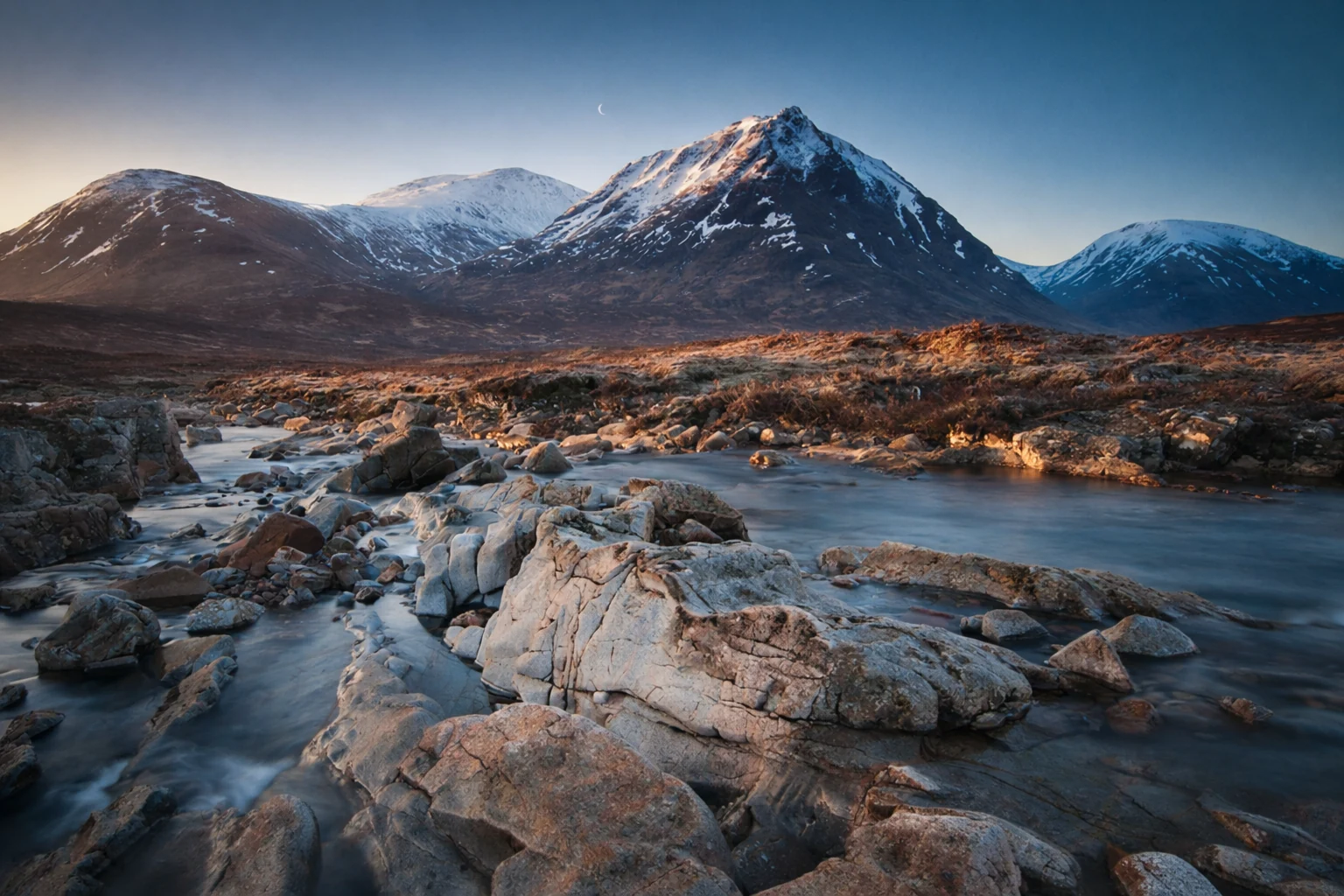
Is November a Good Time to Visit Scotland?
For most travellers, yes, and for some the off-season is the point rather than a compromise. November is one of the cheapest months of the year to travel in Scotland, and the busiest places thin out. One advantage that gets surprisingly little attention is the lack of midges: VisitScotland puts the midge season at May to October, so by November they are no longer something you need to plan around.
What you gain: roughly 38% off summer room rates, empty lay-bys at Glencoe and Loch Ness, no midges and little tick activity, the year's best aurora darkness, the arrival of some 400,000 pink-footed geese, and light so low that there is no harsh midday sun at all.
What you give up: around two hours of daylight compared with October, about half of Scotland's ticketed heritage sites, the Jacobite steam train, any prospect of skiing, and the reliability of ferry travel to the islands.
November works best when you are happy doing one or two good things a day rather than trying to fit in a full summer sightseeing schedule. The days are short, but if you are travelling for landscapes, atmosphere and quieter places, that can be a very good trade. The season-by-season comparison puts it in context against the rest of the year.
Other Experiences You Might Enjoy
November visitors rarely drive themselves. The usual shape of the trip is a city base with guided days out — Glencoe and Rannoch Moor down the A82, a Loch Ness cruise to Urquhart Castle, the run west to Eilean Donan Castle and the Isle of Skye, or the Glenfinnan Viaduct in winter light. Departures from Edinburgh, Glasgow and Inverness all run year-round, and in a month of short days and wet roads a driver who knows the glen is worth the fare on its own. The suggestions below are matched automatically to these Scottish Highlands destinations and experiences.
Early or Late November? Edinburgh Changes on the 14th
For Edinburgh in particular, the first and second halves of November feel quite different in 2026. Up to the 13th it is one of the cheapest and quietest fortnights in the Scottish calendar. From the 14th, Edinburgh's Christmas opens in East Princes Street Gardens and runs to 3 January, and the capital gets busier and more expensive with it.
Layered on top of that, three of November's four weekends are Murrayfield internationals: Scotland play New Zealand on Saturday 7 November, Australia on Sunday 15 November and Japan on Saturday 21 November. Between the rugby and the market, most November weekends in Edinburgh are busier than you might expect for the off-season.
None of this applies to the Highlands. Glencoe, Fort William and the west coast are quiet all month, and a Murrayfield weekend is a reason to be out of the city, not a reason to stay home.
How Cold Is It, and Does It Snow?
Milder than most visitors expect, and drier than its reputation. The average daytime maximum for Scotland as a whole is 8.0°C in November. November is actually slightly drier than October and December in the Met Office national averages, although it has far less sunshine than October.
| Scotland average | October | November | December |
|---|---|---|---|
| Rainfall | 168.2 mm | 165.2 mm | 173.9 mm |
| Rain days | 18.0 | 18.5 | 18.2 |
| Sunshine | 74.7 hrs | 47.6 hrs | 29.7 hrs |
| Mean maximum | 11.3°C | 8.0°C | 5.8°C |
Met Office HadUK-Grid areal averages for Scotland.
What actually changes between October and November is sunshine: 47.6 hours for the whole month, about 1.6 hours a day. In the west Highlands it is starker still, at roughly 40 to 50 hours across 18 to 23 rain days.
The east-west split matters more than the calendar. Edinburgh gets 65.3 mm of rain over 11.7 rain days; Skye gets 204.6 mm; Lerwick has 21.5 rain days. By temperature, Tiree is the mildest place in the table at 10.2°C by day, and Braemar the coldest at 7.4°C with 10.9 nights of air frost.
Snow: on the tops, usually. First snow above roughly 700 metres is normal by mid-month, and it is regular from November in Glen Coe. Full winter conditions across all the Munros by mid-November happen about one year in three. At road level it is less common but real — a cold wave on 17–21 November 2025 took Tomintoul to −12.6°C, the lowest British November night in 15 years.
How Much Daylight Do You Actually Get?
Between about 9 hours at the start of the month and about 7 hours 20 minutes at the end — and that is the single biggest constraint on a November trip. The clocks went back on 25 October 2026, so sunset already feels abrupt before November begins.
| Place | 1 November | 30 November | Sunset on the 30th |
|---|---|---|---|
| Edinburgh | 9h 17m | 7h 32m | 15:47 |
| Fort William & Glencoe | 9h 11m | 7h 22m | 15:49 |
| Inverness | 9h 07m | 7h 13m | 15:42 |
Computed for 2026. Check a sunrise calculator for your exact dates.
The number that matters: by 30 November, Edinburgh has only about half an hour more daylight than the winter solstice. Late November is, in daylight terms, already midwinter.
For photographers, there is an upside: the sun stays low all day. At Glencoe the sun peaks at 18.8° above the horizon on 1 November and only 11.6° on the 30th, so there is no harsh midday light in the month at all. The combined golden-hour window runs between 2 hours 47 minutes and 3 hours 29 minutes a day, and it starts at a civilised hour — first light is around 07:00 to 07:45, not the 04:00 start a summer photographer needs.
One practical consequence catches people out repeatedly: Edinburgh Castle's winter last entry is 16:00, which is before sunset but leaves no room for a leisurely afternoon. Book timed entries early in the day and treat 15:00 as the end of useful sightseeing light.
Is November Really Cheaper?
Yes. The difference from summer prices is substantial. Scottish hotels averaged £127.25 a night in November 2025 against £206.91 in August 2025 — a fall of 38.5%, or £79.66 every night. Over a five-night stay, that works out at nearly £400 less.
Rail fares help too. ScotRail abolished peak fares permanently on 1 September 2025, which took an Edinburgh to Glasgow return from £32.60 to £16.80, and Elgin to Inverness from £24.80 to £16.30. For a trip based in cities with day trips out, that is a real second saving.
Two things push the other way, and both are new. Edinburgh's visitor levy applies to stays from 24 July 2026 at 5% before VAT, capped at the first five consecutive nights — roughly £6.40 on a £127 room, or about £32 across five nights. That reclaims around 8% of the saving, so it trims the discount rather than erasing it. The UK Electronic Travel Authorisation is a flat £20 a head for non-visa nationals, which is £80 for a family of four and the one line that is genuinely worse on a cheaper trip.
The exception to all of it is Edinburgh on a rugby weekend. On 7, 15 and 21 November 2026 the capital prices like peak season, and booking those dates blind can return the entire off-season saving.
What Is Closed in November?
Roughly half of Scotland's ticketed heritage. Historic Environment Scotland runs a winter season from 1 November to 31 March, and 29 of its 61 ticketed sites, about 47%, close for it. That includes every site reached by boat, so Inchmahome, Inchcolm and Lochleven are all unavailable.
The sites that stay open shorten their hours, which matters more than it sounds when sunset is at 15:47. Two scheduling traps catch people out: Iona Abbey closes every Sunday in winter, and Dunstaffnage closes every Thursday and Friday.
- Open, and free: the National Trust for Scotland's Glencoe Visitor Centre, daily 09:30–16:00 from 2 November, free entry with a £4.00 car park.
- Open on winter hours: Edinburgh Castle, daily 09:30–17:00 with last entry at 16:00, £23.50 adult online.
- Open, but check the day: Glenfinnan Monument visitor centre, 09:30–16:00 from 2 November; the monument itself is £5.00. The Viaduct View Cafe is closed from 17 September until 31 March 2027.
- Finished for the year: the Jacobite steam train, whose 2026 season ran 1 June to 23 October. The year-round ScotRail West Highland Line covers the same route in November.
- Not open yet: every Scottish ski centre. CairnGorm is scheduled for 5 December and Glencoe Mountain, Nevis Range, Glenshee and The Lecht for 19 December.
Distilleries are different: most remain open, although winter hours are shorter. The quiet season for production is usually July — so a November visitor is more likely to see a distillery actually working than an August one.
Glencoe and the Highlands in November
November works particularly well in Glencoe and the west Highlands. The Highland honeypots that are difficult in summer are effortless in November: there is space in the lay-bys at the Three Sisters, room at Glencoe Lochan, and no queue anywhere. The visitor centre is open daily on winter hours and costs nothing to enter.
One practical thing to know about Glencoe in November is how little direct sun reaches the floor of the glen. The floor of the Glencoe pass sits beneath walls that rise 25 to 35 degrees above it, while the November sun never climbs past 18.8 degrees — so the pass itself stays in shadow all month, and the light lands on the opposite wall instead. Ten minutes up the road, Rannoch Moor is open enough that it is lit all day. If you want sun on the landscape in November, the moor delivers what the glen cannot.
For most visitors the practical answer is to let someone else drive. The A82 in November spray, in the dark, with deer moving at dusk, is not the introduction to the Highlands anyone wants. A guided day from Edinburgh or Glasgow covers Glencoe, Rannoch Moor and Loch Ness in a single run and gets you back after dark without you having driven a mile of it. If you do drive, our guide to driving the A82 in winter covers the snow gates, this winter's roadworks and where to refuel.
If you are weighing November against the months either side of it, the September, October and November comparison for Glencoe goes through the trade-off month by month, and Glencoe in November covers what is open in the glen and the best low-level walks.
Can You See the Northern Lights?
Your chances are better in November than at any other point in the year, and they are still modest. The limiting factor in Scotland is never latitude. Thurso sits at much the same latitude as Stavanger. What stops you seeing the aurora is cloud. The probability of cloud-free skies over Britain peaks at 33.3% in November, which is why the month outperforms the darker but cloudier ones on either side.
- Shetland: roughly a 35–45% chance across three nights.
- Orkney: roughly 25–35%.
- Caithness and the far north mainland: roughly 15–25%.
- Central Belt: only on a strong storm, and you will hear about it first.
Solar cycle 25 has passed its maximum and is now in its declining phase. Coverage splits on what that means: one reading calls 2026 the last of the peak years, the other points out that the declining phase historically produces the fastest coronal mass ejections and the strongest storms. For a visitor, the practical conclusion is the same: 2026 is still a reasonable year to try, but the aurora should be a bonus rather than the reason for the trip.
Go north, stay three nights or more, get away from town lights, and have something else planned for the other twenty-three hours of the day.
Can You Still Walk in the Hills?
Yes at low level, and with real caution higher up. The fact that changes the answer is one almost no guide mentions: the Scottish Avalanche Information Service does not begin full forecasting until 17 December 2026, and it has never started in November in a decade of records. November hills can carry early snow and windslab with no published avalanche hazard rating at all.
The mountain-rescue figures need some context. November accounted for 16 of 319 mountaineering incidents in 2023, about 5%, against 44 in May. The month is quiet partly because far fewer people are on the hills, not because the ground is safer.
With 7 to 9 hours of daylight, a Munro round that takes 7 to 9 hours in summer has no margin at all. For most visitors, lower-level walks make far more sense in November:
- Glencoe Lochan — flat, waymarked, and the reflections are at their best in still November air.
- Signal Rock and the Loch Achtriochtan shoreline — short, sheltered and close to the visitor centre.
- The Nevis Gorge and Steall Falls — dramatic in high water, which November reliably provides.
- The Lost Valley — only in benign conditions. Once there is snow or ice in it, it needs an axe, crampons and the skill to use them.
Anything on the Aonach Eagach ridge, or Buachaille Etive Mor by Coire na Tulaich, belongs to experienced winter parties in November, not to visitors with summer boots.
What to Pack
Prioritise proper waterproofs over heavy winter clothing. Scotland in November is mild, not freezing, so what beats you is wet and wind, not cold, and the jacket that handles English drizzle will not handle an Atlantic front on the A82.
- A proper waterproof shell and waterproof trousers. The trousers are the item visitors skip and regret.
- Layers, not one thick coat — it is 8°C outside and warm in every pub, museum and minibus.
- Waterproof footwear with grip. Paths are wet, leaf-covered and often icy first thing.
- Hat and gloves, which weigh nothing and change a windy viewpoint entirely.
- A head torch. It is dark by 16:00 and this is the one item nobody thinks to bring.
The full list, including what to leave at home, is in the Highlands packing guide.
From Edinburgh: Loch Ness, Glencoe & Scottish Highlands Tour
In November the case for a guided day is at its strongest. Someone else drives the A82 in the spray and the dark, watches for deer at dusk, and knows which viewpoint will be clear when the cloud lifts for twenty minutes. It runs right through the winter, and it is the tour we point most first-time visitors toward.
The Hairy Coo | From $69 per person | 12.5 hours | 4.7/5 from 12,000+ reviews
Check Availability & PricesWho November Suits — and Who It Doesn't
November particularly suits you if you care more about lower accommodation prices and quieter places than about long sightseeing days: photographers, city breakers, whisky travellers, wildlife watchers, aurora hopefuls, and anyone who has been driven indoors by midges in July.
November is the wrong call if you came to ski, if your itinerary depends on a chain of ferries, or if you are driving the North Coast 500 on a fixed schedule — that route's distances assume daylight it does not have in November. It is also wrong if one specific seasonal attraction is the point of the trip; check its dates before booking anything else.
- Photographers: particularly good, thanks to the low sun and long golden-hour conditions.
- City breakers: good, but choose your dates carefully — before the 14th for quiet, after it for the Christmas markets.
- Whisky travellers: a strong month; most distilleries remain open, and production is usually running.
- Price-conscious travellers: one of the better-value periods before Christmas.
- Hillwalkers with winter skills: workable, provided you plan around the absence of an avalanche forecast.
- Families with young children: possible, with an indoor-led plan and low expectations of daylight.
- Island hopping on a multi-ferry route: difficult; winter timetables and weather make a chain of crossings a poor bet.
- Skiers: too early; the main ski centres do not open until December.
So, Is Scotland Worth Visiting in November?
If quieter places and lower prices matter more to you than long sightseeing days, the first half of November is especially attractive. In 2026, 9–13 November falls between the autumn events and the opening of Edinburgh's Christmas, while the Highlands stay quiet throughout the month. A Highland day tour is worth considering, so the short daylight is spent looking out of the window rather than driving.
Come in the second half instead if the Christmas markets are part of the appeal — from 14 November Edinburgh is a different and more festive city, at a price. Either way, avoid booking the capital blind on 7, 15 or 21 November unless you want to be there for the rugby.
What you will not get is a full sightseeing programme. Half the castles are shut, the light goes at four, and the hills want winter skills. Plan less than you would in summer, keep a wet-weather option in reserve, and November can be a very rewarding time to see Scotland — especially if the quieter Highlands are what you came for.
Frequently Asked Questions
Ready to Plan the Trip?
Once you have picked your week, these are the next two decisions.
- Which tour, and from where?
Compare Highlands tours from Edinburgh › - How many days do you need?
Highlands itinerary planner ›
See the Highlands With the Place to Yourself
Our top-rated Highlands day tours from Edinburgh run right through November — Glencoe, Rannoch Moor and Loch Ness at their starkest, with someone else driving the dark roads.