Last updated — dates, opening hours and train times checked for the 2026 autumn season.
Is Glencoe worth visiting in autumn? Yes, but not for the reason most people assume. Autumn does not give you better weather here. It gives you better atmosphere. Rust-gold bracken against wet grey rock, stags roaring across the glen at dusk, the first snow settling on the Munros while the glen floor is still amber, and lay-bys that finally have space in them.
What you pay for that is real: October and November are among the wettest and cloudiest months anywhere in inhabited Britain, daylight collapses from roughly 14 hours on 1 September to about 7 hours by the end of November, hill conditions turn wintry, and some seasonal businesses wind down. That trade-off — atmosphere against practicality — is the whole story of a Glencoe autumn, and why the three months are genuinely different trips rather than three shades of the same one.
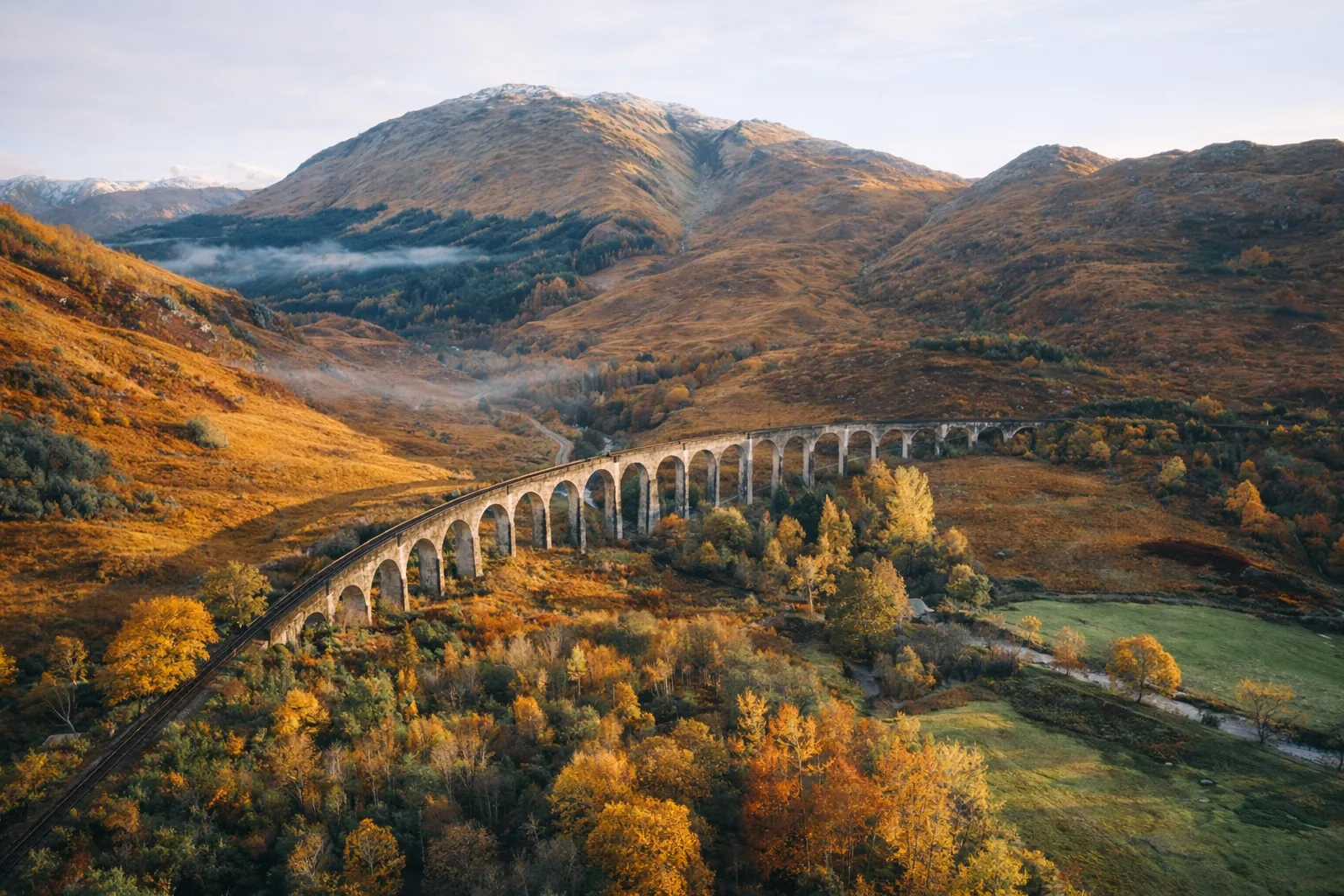
Is Autumn a Good Time to Visit Glencoe?
Yes, with one important qualification. Autumn is not Glencoe's best-weather season, and any guide that tells you otherwise is selling you something. The months most regulars name as the best all-round windows are May, June and September: long days, milder air, and by the end of that run, fewer midges. What autumn does is trade reliability for character.
What you gain: glens turning gold and rust, red deer rutting within earshot of the road, low-angle light all day, the first snow on the Munros, a genuine drop in visitor numbers, and the best dark-sky and aurora odds of the year.
What you give up: a great deal more rain, daylight disappearing at roughly half an hour a week, hill conditions that turn wintry from mid-October, and a slow shutting-down of seasonal services through November.
If you want a straightforward sightseeing trip with easy daylight and everything open, come in late spring or summer instead. If you want the version of Glencoe that photographs like a painting and sounds like a wildlife documentary, autumn is exactly right — you just need to pick the correct month.
Other Experiences You Might Enjoy
Autumn visitors to Glencoe usually build a wider Highland trip around it — a Loch Ness cruise to Urquhart Castle, the run west to Eilean Donan Castle and the Isle of Skye, or a stop at the Glenfinnan Viaduct for the Jacobite steam train while it is still running. Departures from Edinburgh, Glasgow and Inverness cover all of them, and a guided day is a useful hedge in a season this wet — a driver who knows the glen will chase the clear windows for you. The suggestions below are matched automatically to these Scottish Highlands destinations and experiences.
The Short Answer: October Is Best Overall
October is the best month overall for most visitors — especially for scenery and photography — but it is not the best choice for everyone. It is the only month of the three that stacks everything at once: peak autumn colour, the tail end of the red deer rut, the first snow dusting the tops, low sun for most of the day, the visitor centre still on daily hours, and the Jacobite steam train still running until the 23rd.
The catch is that everyone else has worked this out too. The Highland October break runs 12–23 October 2026 (pupils go back on the 26th) and English half-term lands in the same window, so a normally quietening glen gets a sharp two-week spike in demand. If you can, aim for 6–11 October or 24–31 October and bracket the break entirely.
That is the general answer. The useful answer depends on what you are actually coming for, and that is where the three months separate.
September vs October vs November at a Glance
One row per month, with the trade-off stated plainly. Everything below this table is the detail behind it.
| Month | Best for | Main advantage | Main drawback | Daylight |
|---|---|---|---|---|
| September | Walking & first-time visits | Longest days, mildest conditions, everything still open | Less autumn colour, still busy, higher prices | ~14 hrs → ~11h 40m |
| October (our pick) | Scenery & photography | Peak colour, deer rut, possible first snow, Jacobite until the 23rd | Wetter, plus a school-holiday spike 12–23 October | ~11h 34m → ~9h 10m |
| November | Solitude & dark skies | Quiet, dramatic, cheapest, best aurora darkness | Very short days, wintry hills, more closures | ~9h 03m → ~7h 15m |
Daylight figures are for Ballachulish/Fort William, first to last day of each month, 2026. The late-October and November figures are close estimates, so check a sunrise calculator for your exact dates.
September: Best for Hiking and Long Days

September is really late summer wearing an autumn label. The month opens with close to 14 hours of daylight and closes with 11 hours 40 minutes, average highs sit around 15°C, and the whole tourist apparatus is still running at something like full capacity. The colour has barely started at glen level — a few birches and rowans turning high up by the end of the month — so if autumn foliage is the reason you are coming, September will disappoint you.
What it is unbeatable for is walking. Bidean nam Bian, Buachaille Etive Mòr, Stob Coire nan Lochan, the Aonach Eagach and Ben Nevis are all in summer condition, with enough daylight to start at a civilised hour and still have margin at the other end. The West Highland Way is still fully supported by open accommodation along the route. Midges are still in season in September (VisitScotland puts the season at May to October), so bring repellent.
Two things to plan around. September is still busy and priced accordingly, and two big events tighten local beds: the Ben Nevis Race on Saturday 5 September 2026 and Salomon Skyline Scotland at Nevis Range, 18–20 September 2026. The deer rut also starts building from mid-month, so the last week of September gives you a preview of October's best wildlife without October's rain.
Choose September if your priority is hiking rather than autumn colour — or if this is a first Highlands trip and you want daylight, open cafés and the fewest weather-related limitations. Our Scotland road trip itineraries assume exactly these conditions.
October: Best for Autumn Colour and Photography
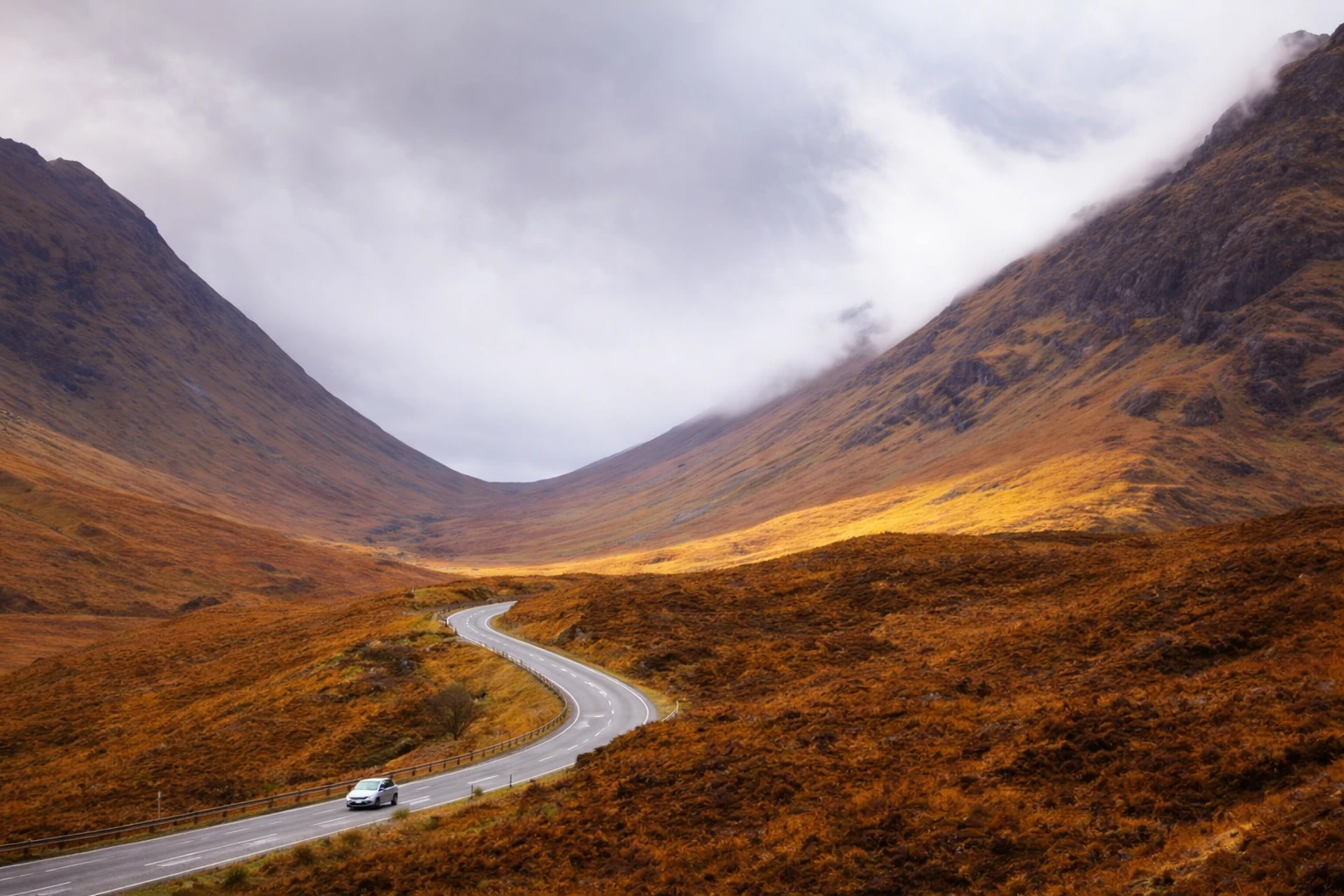
October is the transition month, and that is exactly why it wins. Colour peaks in the Highland glens in the first half of the month and holds through the second. The rut is at full volume into mid-October. First snow typically dusts the Glencoe Munros and Ben Nevis from mid-month — it often melts within days, but a snow-dusted ridge above a gold glen is the shot people come here for. And because the sun never gets high, the light stays photographic from breakfast to dusk.
Practically, October is still a workable month. Daylight runs from 11 hours 34 minutes on the 1st down to about 9 hours 10 minutes on the 31st. The NTS Glencoe Visitor Centre is open daily 09:30–17:30 to 4 October, then daily 09:30–17:00 from 5 October. The Jacobite steam train runs its morning service until 23 October. Nothing important has closed yet.
The drawbacks are real. Rainfall steps up sharply — weather services put October somewhere between 107 mm and 198 mm across roughly 24 rain days, with only about 2.4 hours of sunshine a day. The 12–23 October school break crowds the glen. And on 25 October the clocks go back, which costs you an hour of afternoon light overnight — pack a headtorch from that date on.
One more October-specific point for walkers: the red deer stag season's busiest stretch is the first three weeks of the month, to 20 October. You have an unconditional right of responsible access under the Land Reform (Scotland) Act 2003, and the National Trust for Scotland does not restrict access for stalking on its Glencoe and Dalness estate, but neighbouring estates in Glen Etive, Blackmount and the Black Corries may well be stalking, so check NatureScot's Heading for the Scottish Hills service before a hill day.
Choose October if you want the full autumn spectacle — colour, deer, first snow, low light, and can either book around 12–23 October or accept company while you are there.
November: Best for Solitude and Early-Winter Atmosphere
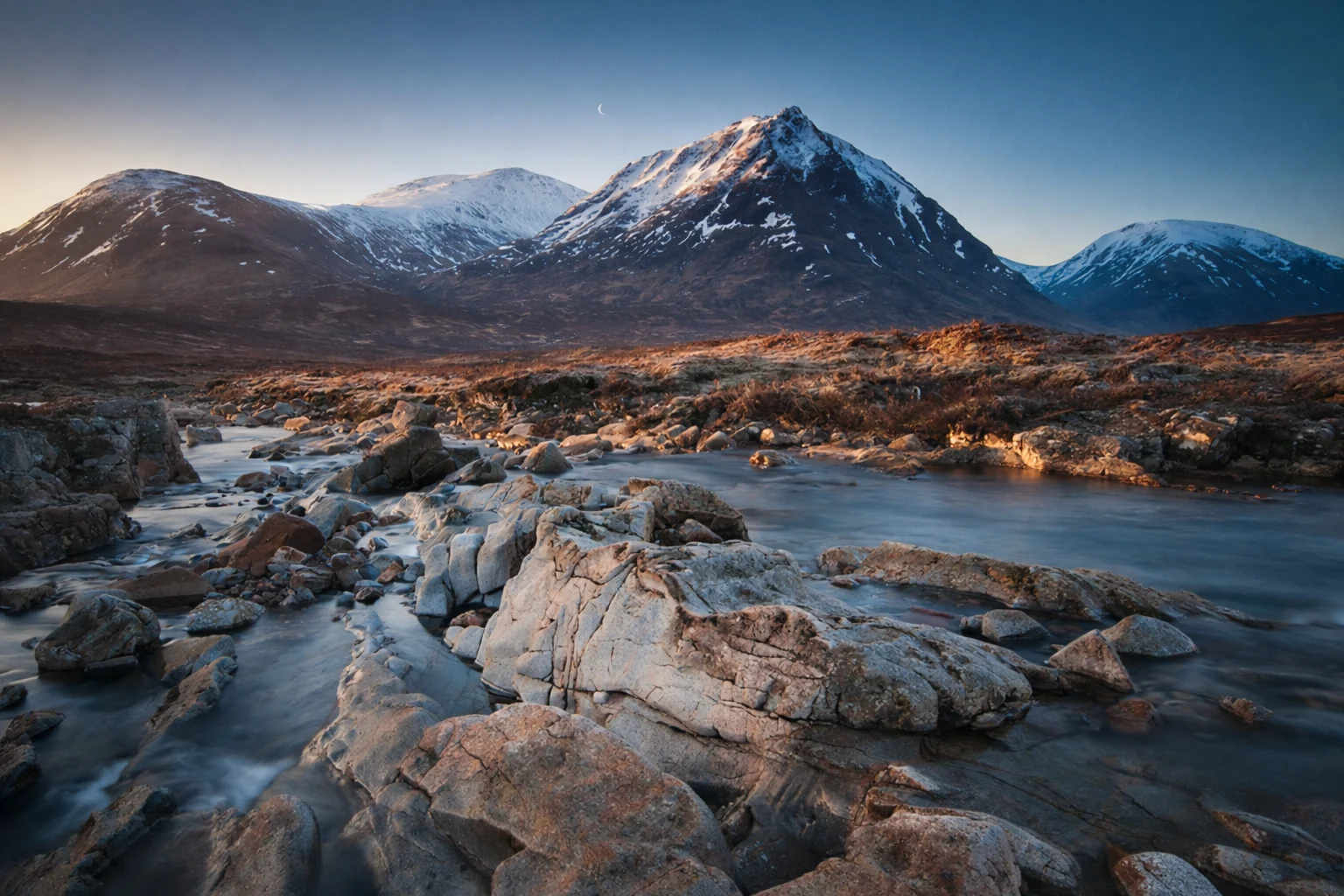
November is a different trip, not a lesser one. The leaves are largely gone — autumn gales strip the trees — but the tawny moorland grasses hold their colour, the mountains are bare and architectural, and snow on the tops becomes increasingly likely. Average highs are around 9°C, glen-floor nights hover near freezing, and there is roughly an hour and a half of sunshine a day. It is the year's starkest version of Glencoe.
The compensation is space. November is genuinely quiet: no school break, no queue at the Three Sisters lay-bys, the lowest accommodation prices of the year before Christmas and the ski season lift them again, and often the ability to book close to travel. It is also the best of the three months for dark skies — long nights, very little light pollution across Rannoch Moor, and Glen Nevis nearby as a Dark Sky Discovery Site. Solar Cycle 25 passed its maximum in October 2024 and is in its declining phase, but the largest flares of a cycle often come in exactly that phase, so 2026 remains a decent aurora year by historical standards. The limiting factor in Lochaber is cloud, not darkness or latitude — set expectations accordingly and treat a clear night as a gift.
What you lose is flexibility. Daylight falls from about 9 hours to roughly 7 hours 15 minutes — barely more than the winter solstice — so a Munro day means starting at first light with a headtorch in the pack regardless. Rivers run in spate after rain, the Aonach Eagach becomes a serious winter mountaineering route rather than a scramble, and microspikes or full winter kit belong in the car. The visitor centre stays open daily (09:30–16:00 from 2 November), but cafés and restaurants in the village, Ballachulish and Fort William increasingly cut hours or close midweek.
Choose November if atmosphere and solitude matter more to you than ease and flexibility, and if you are equipped for genuinely wintry conditions on the hill.
If you are weighing November across Scotland as a whole rather than Glencoe specifically — prices, closures, daylight and the mid-month split in Edinburgh — see is November a good time to visit Scotland? For November in the glen alone, with this year's opening hours and sunrise times, see Glencoe in November.
When Does Glencoe Get Its Best Autumn Colour?
Mid-to-late October is the answer for the Highland glens. The sequence runs roughly like this: birches and rowans turn first at altitude in late September; the glens hit their peak in early-to-mid October; larches carry the display on into early November before the storms take them.
Where to point the camera:
- Glencoe Lochan — planted by Lord Strathcona with North American species, including cedars, larches and spruce, which gives it unusually varied colour and still-water reflections you will not get elsewhere in the glen.
- Glen Etive — the single-track glen running south, at its best in the first low sun of the morning.
- Glen Nevis — broader, wooded, and an easy pairing with a Fort William base.
- Loch Leven and the Ballachulish shore — reflections and shoreline birch.
- Rannoch Moor — not trees at all, but the vast tawny expanse most people remember longest.
Glencoe's real autumn signature is not woodland. It is the moorland grasses and bracken turning deep amber, rust and gold against wet grey rock, across an enormous open landscape. That colour arrives earlier and lasts considerably longer than the leaves do, which is why a trip in early November can still look thoroughly autumnal even with the trees bare. For where to stop and what to see, our complete guide to Glencoe covers the viewpoints in order along the A82.
What Is the Weather Really Like?
Wet. Genuinely, exceptionally wet. The Royal Meteorological Society, citing the Met Office, records that "on average… 3,300 mm of rain fall on Glen Etive each year, and it rains on more days than it doesn't" — over 150 mm more than Seathwaite in Cumbria, long billed as England's wettest inhabited place. The measuring point is the Dalness estate in Glen Etive, the closest inhabited spot to Glencoe. October and November are the wettest part of that already remarkable year.
| Variable | September | October | November |
|---|---|---|---|
| Average daily max | ~15°C | ~12°C | ~9°C |
| Average daily min | ~9°C | ~5°C | ~3°C |
| Monthly rainfall (range across sources) | ~77–130 mm | ~107–198 mm | ~135–186 mm |
| Rain days | ~19 | ~24 | ~23 |
| Sunshine per day | ~4 hrs | ~2.4 hrs | ~1.5 hrs |
| Loch water temperature | ~13–14°C | ~12°C | ~10°C |
Figures use a Fort William proxy and vary substantially between weather services — no gauge sits inside Glen Coe itself, and most models draw on Oban or a modelled Fort William point, which understate the glen. Treat them as directional. The one thing every source agrees on is that rainfall climbs steeply from September into October and stays high through November.
Wind and storms. The storm-naming season runs from 1 September, and the Met Office released the 2026–27 list with Met Éireann and KNMI for the start of meteorological autumn — Austen, Boelo, Chloe, Dano and Evelyn lead it, chosen from more than 40,000 public nominations in the eleventh year of the scheme. The first named storms of a season usually arrive in autumn, and the west Highlands sit directly in the path of Atlantic frontal systems, so gales are routine in October and November.
Snow. First snow generally dusts the Glencoe Munros and Ben Nevis from mid-October, often melting quickly; a cold snap can bring it to the glen floor by late October. Full ice-axe-and-crampons winter conditions typically establish from late November into December, with meaningful accumulation usually holding off until mid-to-late December. The Scottish Avalanche Information Service forecast for Glencoe has historically started around mid-December, and Glencoe Mountain Resort's ski season generally runs mid-December to early April. A late-November opening is the exception, not the rule.
What to pack. Full waterproofs — jacket and trousers, not a shower-resistant coat — plus waterproof footwear and quick-dry layers, in all three months. Add midge repellent in September; hat, gloves, walking poles and a headtorch in October; and full winter warmth plus microspikes for any November hill day, with MWIS checked the night before. Our Highlands packing list has the full version.
How Much Daylight Do You Lose Through Autumn?
More than most visitors expect, and the single biggest practical difference between the three months. Glencoe loses roughly half its usable light across the season.
| Date (2026) | Sunrise | Sunset | Daylight |
|---|---|---|---|
| 1 September | 06:21 | 20:19 | 13h 57m |
| 30 September | 07:20 | 19:00 | 11h 40m |
| 1 October | 07:23 | 18:57 | 11h 34m |
| 31 October | ~07:35 | ~16:45 | ~9h 10m |
| 1 November | ~07:38 | ~16:42 | ~9h 03m |
| 30 November | ~08:32 | ~15:47 | ~7h 15m |
Ballachulish/Fort William. The September and 1 October rows are calculator-verified; the late-October and November rows are close estimates, so check them for your exact dates.
The date that catches people out is 25 October 2026, when British Summer Time ends at 02:00 and the clocks go back an hour. Sunset drops from about 17:45 on the 24th to about 16:43 on the 25th, overnight. If your trip straddles that weekend, plan the second half around a much earlier dusk.
For context, the winter solstice on 21 December 2026 gives 6 hours 52 minutes, so late November sits far closer to midwinter than to autumn. Seven hours of light means one objective a day rather than three, a headtorch as standard kit, and any Munro attempt starting at first light.
The Red Deer Rut and Autumn Wildlife
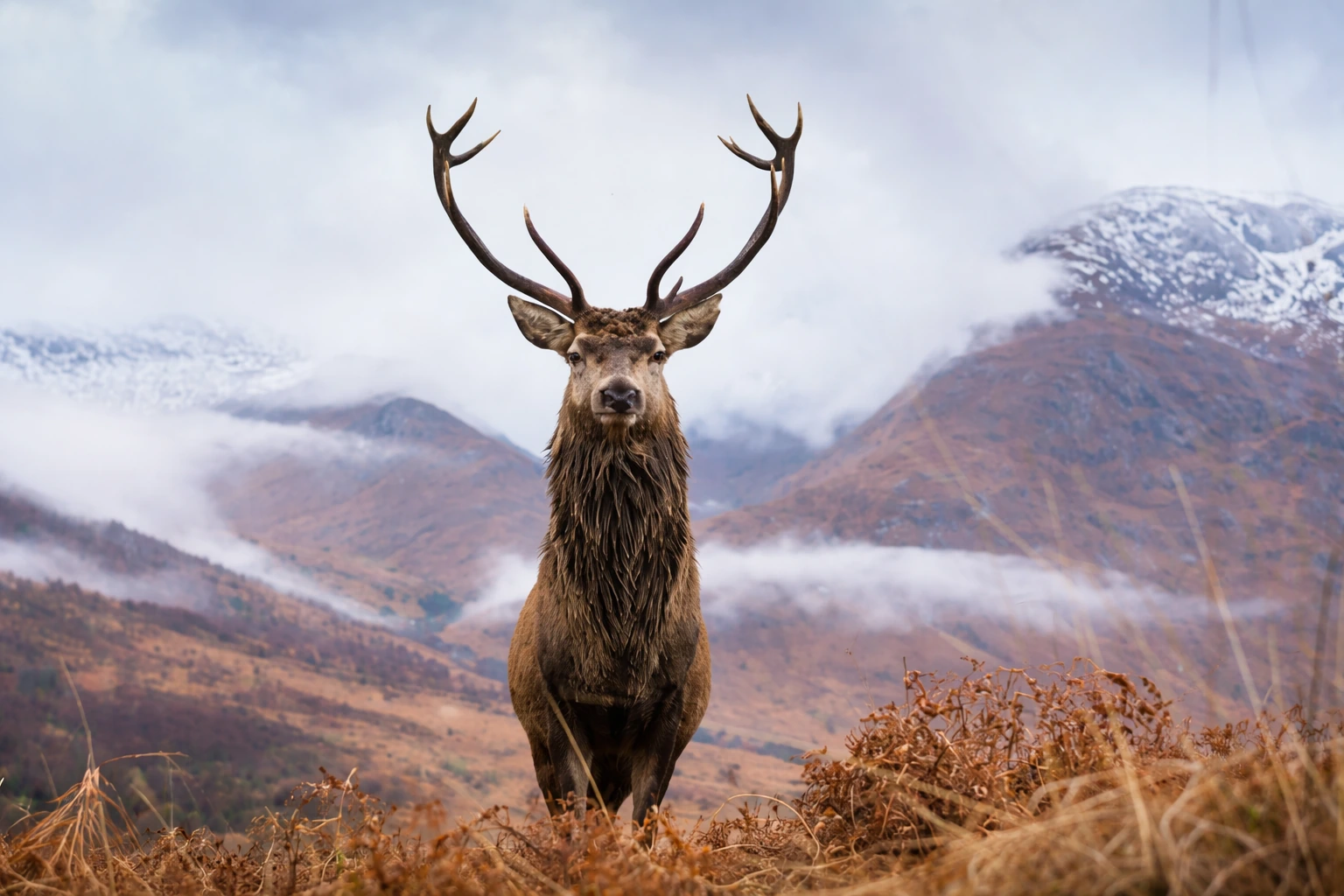
The rut runs from roughly mid-September to early November, peaking from late September to mid-October. From the last week of September the glens start echoing with roaring stags, and Glencoe and Glen Etive are both reliable places to hear it — often from the roadside at dawn or dusk, without any walking at all. It is the strongest single argument for timing an autumn trip to the very end of September or the first half of October.
Two cautions. The National Trust for Scotland asks visitors to give rutting deer plenty of space; a stag in the rut is not a photo opportunity to approach. And deer-vehicle collisions are a genuine autumn risk on the A82 and on single-track roads like Glen Etive's, particularly at dawn and dusk. Drive slowly, expect animals on the tarmac, and use the passing places properly.
Beyond the deer, autumn brings golden eagles over the ridges, red squirrels in the woodland, the salmon run at its best in October, whooper swans arriving to winter on Loch Achtriochtan, geese moving through, and mountain hares beginning to turn white in November.
On the stalking side, the stag season's busiest period is the first three weeks of October, to the 20th, after which hind stalking runs from 21 October to 15 February. Stalking does not legally close the hills — access rights under the Land Reform (Scotland) Act 2003 are unconditional — but checking NatureScot's Heading for the Scottish Hills service before an October hill day is the courteous and sensible thing to do, hill by hill.
What Starts Closing in October and November?
Less than the internet suggests, but enough to change how a trip feels. The headline is that Glencoe's core infrastructure stays open. It is the edges that thin out.
- NTS Glencoe Visitor Centre — open daily all autumn. Daily 09:30–17:30 to 4 October, daily 09:30–17:00 from 5 October to 1 November, and daily 09:30–16:00 from 2 November to 23 December. It does not close in November or drop to weekends only. Admission is free, parking is £4 per car (£6 motorhome) and free for NTS members; the national nature reserve itself is open daily year-round.
- Glencoe Mountain Resort chairlift — year-round for sightseeing, at roughly £20 adult, £15 child and £65 family for a return ride, with reduced low-season café hours. The ski season proper starts mid-December.
- Nevis Range gondola — annual autumn maintenance. It closes for a few weeks each autumn, historically reopening around mid-December for the winter season. The 2026 dates are unconfirmed, so check before relying on it.
- Clachaig Inn and Kingshouse Hotel — generally year-round, and both make reliable autumn and winter bases.
- Cafés and restaurants in Glencoe village, Ballachulish and Fort William increasingly reduce hours or close midweek through November.
- Hostels, bunkhouses and campsites vary — several stay open with reduced facilities rather than closing outright. Confirm directly with the Red Squirrel Campsite, Invercoe Highland Holidays or Glencoe Independent Hostel before you rely on a bed.
- The Corran Ferry switches to its relief vessel. MV Corran begins its annual refit on 1 November 2026, with the 51-year-old Maid of Glencoul covering — smaller vehicle capacity, slightly longer crossings and no dangerous goods. This affects Ardgour and Ardnamurchan instead of the A82 through Glencoe itself, but the 2025–26 refit overran badly, so build in contingency if your route depends on it.
- The West Highland Way winds down through October as accommodation along the route closes; November through-walking is not generally advised.
Public transport holds up better than people expect. Scottish Citylink's 914, 915 and 916 services between Glasgow, Loch Lomond, Glencoe, Fort William and Skye run year-round on a reduced winter timetable, and the ScotRail West Highland Line and Caledonian Sleeper both run all year. The train is a genuinely good wet-weather hedge, because the scenery still works from inside a warm carriage. The A82 through the glen stays open year-round but has snow gates and can close temporarily in heavy snow; from November, treat ice and spray as the default driving condition.
Is the Jacobite Steam Train Still Running?
In October, yes. In November, no — and this is one of the clearest practical reasons to choose the earlier month.
The 2026 Jacobite morning service from Fort William to Mallaig, over the Glenfinnan Viaduct, runs daily from 1 June to 23 October. The afternoon service ran only from 10 June to 25 September. After 23 October the Harry Potter train is unavailable until spring.
Fares for 2026, as published by West Coast Railways: £76 adult and £43 child for a day return in Standard, £116 and £76 in First Class, plus a minimum £3.75 booking fee. It is return-only — there are no one-way tickets — and a Private Table for Two in First Class is £252. Note that the 2026 season started around two months late after a carriage central-door-locking safety dispute, with bookings only reopening on 4 June, so peak dates have been selling out within days of release. Book the moment you have your dates.
If the train is central to your trip, that alone settles the month for you: come before 23 October. Pair it with Glencoe and the second half of October gives you the train and peak colour in the same week.
From Edinburgh: Loch Ness, Glencoe & Scottish Highlands Tour
In a season this wet, a guided day is worth the money: someone else drives the A82 in the spray, watches for deer at dusk, and knows which viewpoint will be clear when the cloud finally lifts. This one runs right through autumn and winter, and the tour we point most first-time visitors toward.
The Hairy Coo | From $69 per person | 12.5 hours | 4.7/5 from 12,000+ reviews
Check Availability & PricesWho Should Visit Glencoe in Autumn — and Who Shouldn't
Autumn suits you if you are a photographer, a wildlife watcher, someone who wants the glen without the coach traffic, an aurora or dark-sky hopeful, or a traveller who would rather have one extraordinary hour of light than eight reliable ones. It suits budget travellers too: November is the cheapest month of the year here before Christmas and the ski season take over.
Autumn is the wrong call if you need dependable dry weather, want to fit three or four sights into every day, are travelling with people who tire of being rained on, or plan to do serious hillwalking without winter kit and winter skills from mid-October onward. It is also the wrong call if one specific seasonal attraction is the point of the trip — check its dates before you book anything else.
- Hillwalkers and West Highland Way walkers: September.
- Photographers and first-time autumn visitors: October — ideally 6–11 or 24–31.
- Wildlife and the deer rut: late September to mid-October.
- Aurora, dark skies and solitude: November.
- Lowest prices: November, with the October-break fortnight the one genuinely expensive window in the season.
- Families tied to school holidays: 12–23 October — book early and expect company.
Verdict: Which Month Would We Choose?
Mid-to-late October, and specifically the last week of it. You get peak colour, the tail of the rut, a real chance of first snow on the Three Sisters, the visitor centre on daily hours, and — up to the 23rd — the Jacobite. You dodge the school-break fortnight. The only price is the clocks going back on the 25th, and by then you have had your colour.
If your trip is built around walking instead of looking, take September instead and accept that the glen will still be green. If what you want is an empty landscape, a dark sky and the sense that you have the place to yourself, take November and pack for winter.
What none of the three months will give you is dependable weather. Book flexibly, keep a rainy-day option in reserve — a distillery, the West Highland Line, the visitor centre — and treat every clear hour as the bonus it is. That is the correct mindset for a Glencoe autumn, and travellers who arrive with it almost never regret the season.
Frequently Asked Questions
Ready to Plan the Trip?
Once you have picked your month, these are the next two decisions.
- Which tour, and from where?
Compare Highlands tours from Edinburgh › - How many days do you need?
Highlands itinerary planner ›
See Glencoe at Its Most Atmospheric
Whichever autumn month you land on, our top-rated Highlands day tours from Edinburgh run right through the season — Glencoe, Loch Ness and the glens at their gold-and-grey best.