The Short Answer
Guided day tours from Edinburgh to Glencoe and Loch Ness run throughout the year, although visitor centres and Urquhart Castle close earlier in winter. For a 12- to 13-hour tour, daylight is one of the biggest seasonal differences: Glencoe has more than 16 hours of daylight by mid-May but less than seven around the December solstice.
If your dates are flexible, May is the best all-round month for a first visit. Days are already long, western Scotland is generally in its drier spring period, and May is usually sunnier than June.
June is the best choice for maximum daylight, although it is usually a little less sunny than May. July and August are the warmest months, with highs of about 18°C on the coast, but also the main school-holiday season. October suits you if autumn colour matters more than long daylight, although the days are much shorter, wetter weather is more likely and attractions close earlier.
From November to March the Highlands are quieter for sightseeing, although some attractions close for a few days over Christmas and New Year. The higher mountains may be snow-covered, while the glens can be green, brown, frosty or snowy depending on the weather. On the shortest winter days, much of a full-day tour runs in darkness.
VisitScotland gives the midge season as May to October, with peak activity in midsummer. On a coach day tour they are usually a minor inconvenience, and a breeze at the viewpoints helps. They matter more on woodland walks or long stops on calm, damp evenings.
Whatever month you visit, the forecast for your day matters more than the monthly average for mountain views. Low cloud can hide Glencoe's peaks in any season, so choose the clearest forecast day if your plans are flexible.
- Best overall, first trip
- May
- Longest daylight
- June, but less sunny than May
- Warmest weather
- July–August, but busy and wetter
- Long days, usually fewer midges than midsummer
- May
- Autumn colour
- October, with shorter days
- Quieter winter trip
- November–March, shorter days
- Most useful live checks
- Low cloud · rain · wind · daylight
- 16h 25mDaylight at Glencoe, mid-May
- 6h 51mDaylight at Glencoe, mid-December
- 12 to 13 hoursA full-day tour from Edinburgh
- 192 hoursMay sunshine at Dunstaffnage, near Oban, the most of any month
- 95 mmMay rain at Dunstaffnage, against 206 mm in January
Climate figures are Met Office 1991–2020 averages for Dunstaffnage, the nearest station with full records, 33 km south-west of Glencoe. Glencoe itself is wetter.
Glencoe and the Scottish Highlands Month by Month
January and February
Short days in the Scottish Highlands: about 7½ hours of daylight in mid-January, rising to 9½ by mid-February. The higher mountains around Glencoe are often snow-covered, while the glen floor may be green, brown or frosty. These are also among the wettest months on the West Highland coast, and the quietest of the year in every visitor series this page uses. Day tours keep running, but expect part of a full-day tour to be in the dark.
March
Days reach almost 12 hours by mid-month, so more of a tour is in daylight, and the high ground usually still holds snow. It is a quiet month with a winter look to the hills, and it stays wet: around 137 mm of rain at Dunstaffnage, against 92 mm in April.
April
A good early-season month. There are over 14 hours of daylight by mid-April, April is one of the three driest months of the year on the coast near Oban, and snow often lingers on the high tops. Scottish Easter school holidays usually fall around the end of March or in April, and the summer holidays are still ahead.
May
The best overall month for a first trip. Glencoe gets about 16 hours of daylight in mid-May, Dunstaffnage records more sunshine in May than in any other month, and rainfall is close to the year's lowest. The hillsides turn green, and midges appear, although VisitScotland puts their peak in the middle of summer.
June
The longest days, with about 17¾ hours of daylight at Glencoe in mid-June, and rainfall as low as May's. It is less sunny than May on the coast, midges are more active, and Scottish schools break up at the end of the month.
July and August
The warmest months, with average afternoon highs of about 18 °C on the coast, and the school holidays for both Scottish and English families. Both months are wetter than May and June, and midge activity peaks. In August the heather comes into flower and the slopes turn purple, which NatureScot describes as the moment “slopes are now bathed in purple”.
September
Still almost 13 hours of daylight in mid-month, and still busy: every visitor series this page uses stays high in September. It is wetter than summer, at around 141 mm on the coast, and late in the month the red deer rut begins.
October
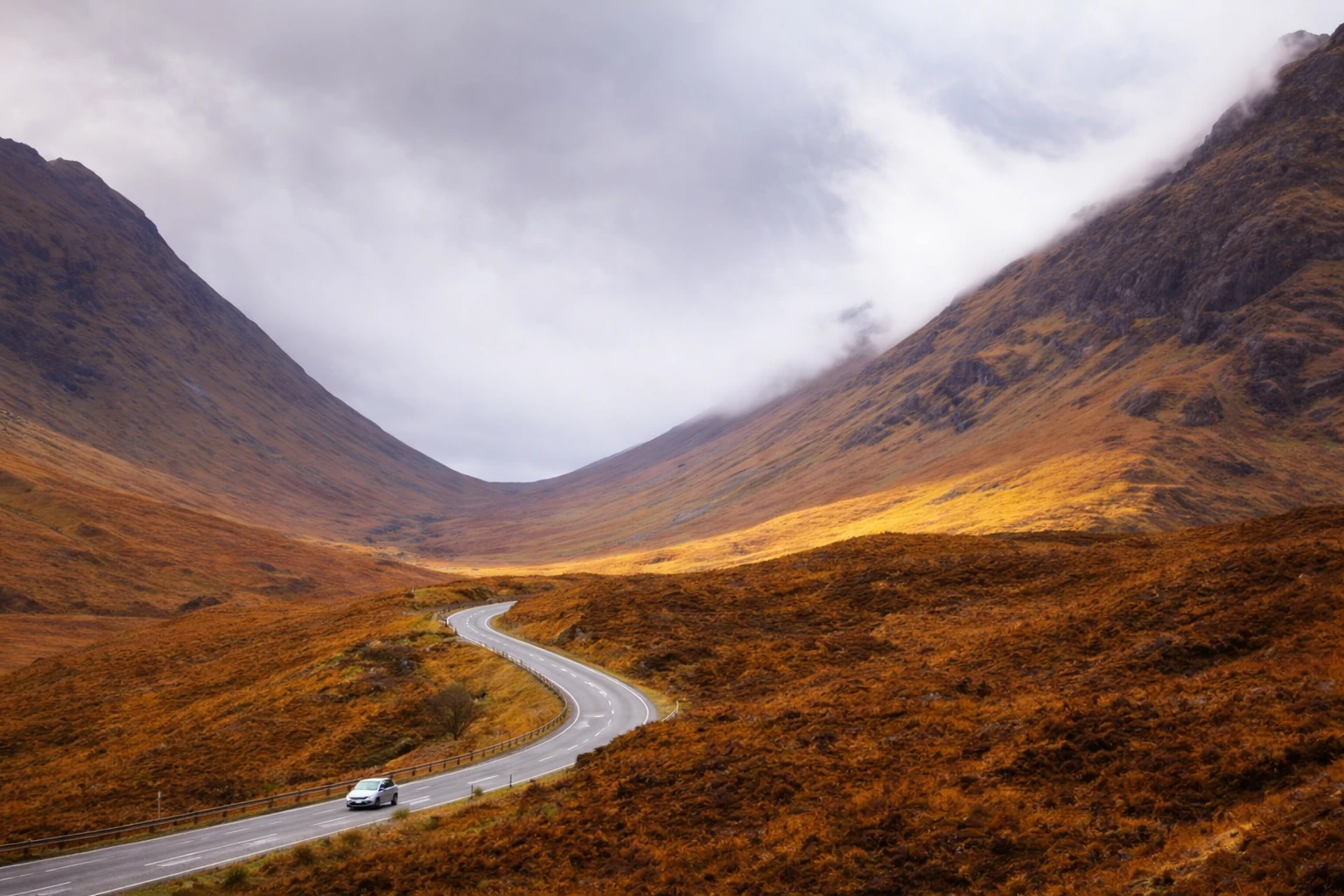
October is the month for autumn colour: VisitScotland calls it peak autumn colour across Scotland, and the bracken on the slopes of Glencoe turns rust and gold. NatureScot says stags can be seen and heard roaring in the rut from late September, and that they “can be aggressive, so keeping a distance is advised”. The costs are shorter days, about 10½ hours in mid-October, one of the wettest months of the year, and earlier closing: Urquhart Castle closes at 17:00 in October, and the Glencoe Visitor Centre at 17:00 from 5 October.
November and December
Quiet months, with snow arriving on the high ground and the shortest daylight of the year: about 8 hours in mid-November and under 7 in mid-December. Christmas and New Year are school holidays in Scotland, and some attractions close for a few days around both.
| Month | Daylight at Glencoe (mid-month) | High / low °C | Rain (mm) | Rain days | Sunshine (hours) |
|---|---|---|---|---|---|
| January | 7h 27m | 8 / 3 | 206 mm | 20 | 32 hours |
| February | 9h 32m | 8 / 3 | 156 mm | 17 | 63 hours |
| March | 11h 45m | 9 / 3 | 137 mm | 17 | 95 hours |
| April | 14h 13m | 12 / 5 | 92 mm | 14 | 147 hours |
| May | 16h 25m | 15 / 7 | 95 mm | 14 | 192 hours |
| June | 17h 45m | 17 / 10 | 96 mm | 14 | 171 hours |
| July | 17h 13m | 18 / 11 | 110 mm | 16 | 135 hours |
| August | 15h 14m | 18 / 11 | 130 mm | 17 | 135 hours |
| September | 12h 51m | 16 / 10 | 141 mm | 16 | 99 hours |
| October | 10h 29m | 13 / 7 | 189 mm | 19 | 78 hours |
| November | 8h 11m | 10 / 5 | 178 mm | 20 | 46 hours |
| December | 6h 51m | 8 / 3 | 198 mm | 20 | 33 hours |
Temperature, rain and sunshine: Met Office 1991–2020 averages for Dunstaffnage near Oban, the nearest station with full records. Rain days are days with 1 mm or more. Daylight is sunrise to sunset at Glencoe, calculated for the 15th of each month.
Other Experiences You Might Enjoy
Building a longer trip around Glencoe and the Scottish Highlands? Add a Loch Ness cruise to Urquhart Castle, a day on the Isle of Skye by way of Eilean Donan Castle, or the Glenfinnan Viaduct on the road to Mallaig. From Edinburgh or Glasgow, Loch Lomond and Stirling make a shorter day out. The suggestions below are matched to these Scottish Highlands destinations.
Check Your Date
Pick a day to see the daylight at Glencoe, the weather forecast (or the monthly average if your date is more than two weeks away), low cloud over the mountains, opening hours at the Glencoe Visitor Centre and Urquhart Castle, and whether the Loch Ness cruises are sailing.
Pick a date to see the daylight, weather and opening hours for your day.
Day tours to Glencoe and Loch Ness are available all year. Glencoe gets about 17¾ hours of daylight in mid-June and under 7 in mid-December.
- Midges: season May to October, peak in mid-summer (VisitScotland).
- Glencoe Visitor Centre: open daily except around Christmas and New Year, with shorter winter hours.
- Urquhart Castle: open daily except 25 and 26 December; last entry one hour before closing.
- Loch Ness cruises: the two main operators sail all year, except 25 and 26 December and 1 January.
Forecasts: Open-Meteo, for Glencoe, inside 16 days. Averages: Met Office 1991–2020, Dunstaffnage near Oban. Opening hours and A82 roadworks last checked in September 2026.
Which Tour Suits Your Month
Most full-day tours from Edinburgh into the Scottish Highlands, to Glencoe and Loch Ness, last 12 to 13 hours, and from Glasgow about 11½ to 12. From April to August that fits comfortably into the daylight. From November to February the same day has far fewer hours of light, so a multi-day tour, which spreads the Scottish Highlands over several days, sees more of the scenery in daylight.
Full-day tour from Edinburgh
The Hairy Coo · 12.5 hours · from $69 · 4.7 from 12,350 reviews
Rannoch Moor, Glencoe, Fort Augustus and Loch Ness in one day, with a cruise, castle or distillery option chosen when you book.
Check AvailabilityThree days from Edinburgh
The Hairy Coo · 3 days · Glencoe, Glenfinnan, Skye and Loch Ness
Glencoe, Loch Ness, Glenfinnan and Skye, spread over three days, so less of the scenery falls after dark when the days are short.
Check AvailabilityFull-day tour from Glasgow
Timberbush Tours · 11.5 hours · Loch Lomond, Glencoe and Loch Ness
A slightly shorter day than the Edinburgh tours, because Glasgow is closer to the West Highlands.
Check AvailabilityFor more options by departure city, see day trips from Edinburgh, day trips from Glasgow and tours from Inverness.
Daylight and a Full-Day Tour
A full-day tour from Edinburgh leaves in the morning and returns in the evening, 12 to 13 hours later. Glencoe gets 17¾ hours of daylight in mid-June and under 7 in mid-December, and that difference decides how much of a day tour you see in daylight.
In practice, from April to August a full-day tour runs mostly in daylight. In October the day has about 10½ hours of light. From November to February daylight is well short of the tour length, so some of the outward or return journey will be after dark. Some operators return earlier in winter or run the route in reverse, which changes where the daylight falls. The date checker above shows sunrise and sunset for any date.
Glencoe is about 1,100 km south of the Arctic Circle, so there is no midnight sun. In June the sky stays light late into the evening, and sunset is after 10 pm.
| Mid-month | Sunrise | Sunset | Daylight |
|---|---|---|---|
| January | 8:46 | 16:13 | 7h 27m |
| February | 7:49 | 17:20 | 9h 32m |
| March | 6:37 | 18:22 | 11h 45m |
| April | 6:14 | 20:27 | 14h 13m |
| May | 5:04 | 21:29 | 16h 25m |
| June | 4:28 | 22:13 | 17h 45m |
| July | 4:50 | 22:03 | 17h 13m |
| August | 5:48 | 21:02 | 15h 14m |
| September | 6:50 | 19:41 | 12h 51m |
| October | 7:52 | 18:20 | 10h 29m |
| November | 8:00 | 16:11 | 8h 11m |
| December | 8:50 | 15:41 | 6h 51m |
Calculated for Glencoe village on the 15th of each month, in UK clock time. Figures agree with published sunrise tables to within a few minutes.
Cloud, Rain and the View on the Day
The mountains are the view at Glencoe, and low cloud can hide the peaks in any month. A clear winter day can show you more of Buachaille Etive Mòr and the Three Sisters than a grey day in June. That is why the forecast for your date matters, and why the date checker shows low cloud as well as rain.
The Met Office describes late spring and early summer as “normally the driest part of the year” in northern Scotland, and at Dunstaffnage near Oban April, May and June each average 92 to 96 mm of rain. October to January are the wettest months, at 178 to 206 mm. Each figure is the total for the whole month, not a daily rate: 95 mm in May spreads over about 14 days with 1 mm or more, and 206 mm in January over about 20. Glencoe itself sits among high mountains and gets more rain than the coast.
Most of a tour is spent inside the coach, and the Loch Ness boats have indoor cabins, so rain matters most at the photo stops and in Fort Augustus. Bring a waterproof in any season.
Midges
VisitScotland puts the midge season at May to October, “with peak activity in the middle of summer”, and says they are found “mainly in the west Highlands, islands, and damp rural areas”. Midges are most active at dawn and dusk and on calm, overcast or damp days, and their activity changes with the wind and humidity.
On a coach day tour they are usually a minor inconvenience rather than a reason to avoid the Highlands: the stops fall in the daytime, when midges are usually less active than at dawn and dusk, and a breeze at the viewpoints helps. They matter more if you are staying overnight in the glen or walking in the evening. From May to October, pack a repellent made for midges. The lowest midge risk is from November to April.
How Busy the Scottish Highlands Get
Nobody publishes a monthly visitor count for Glencoe, Loch Ness or anywhere else in the Scottish Highlands, so this page uses the closest series available. They all point the same way:
- Inverness Airport handled about 42,000 passengers in January 2025 and about 84,000 in May, with every month from May to October close to that level.
- Edinburgh Airport, the nearest airport for tours from Edinburgh, went from under a million passengers in January 2025 to 1.8 million in July.
- Scottish hotel room occupancy in 2024 ran from 36% in January to 91% in August.
- At the Old Man of Storr on Skye, the Highland Council counted roughly 3,500 visitors in January 2023 and about 43,500 in each of July and August.
So July and August are the busiest months in these series, May to October is busy throughout, and January and February are far quieter. Airport passengers include residents flying out, and hotel occupancy counts rooms, not people at a viewpoint, so read them as a guide to the season, not a headcount at Glencoe. Scottish school summer holidays start at the end of June or the start of July, and English holidays run from late July to the end of August.
Snow and Winter Roads
The Met Office says snowfall in the Scottish Highlands and the rest of northern Scotland is “normally confined to the months from November to April”, with brief falls on high ground in October and May, and that snow “rarely lies at lower levels outside the period from November to April”. The mountains around Glencoe hold snow far more often than the glen itself, so in winter you may see white peaks above a glen that is green, brown, frosty or snowy, depending on the weather.
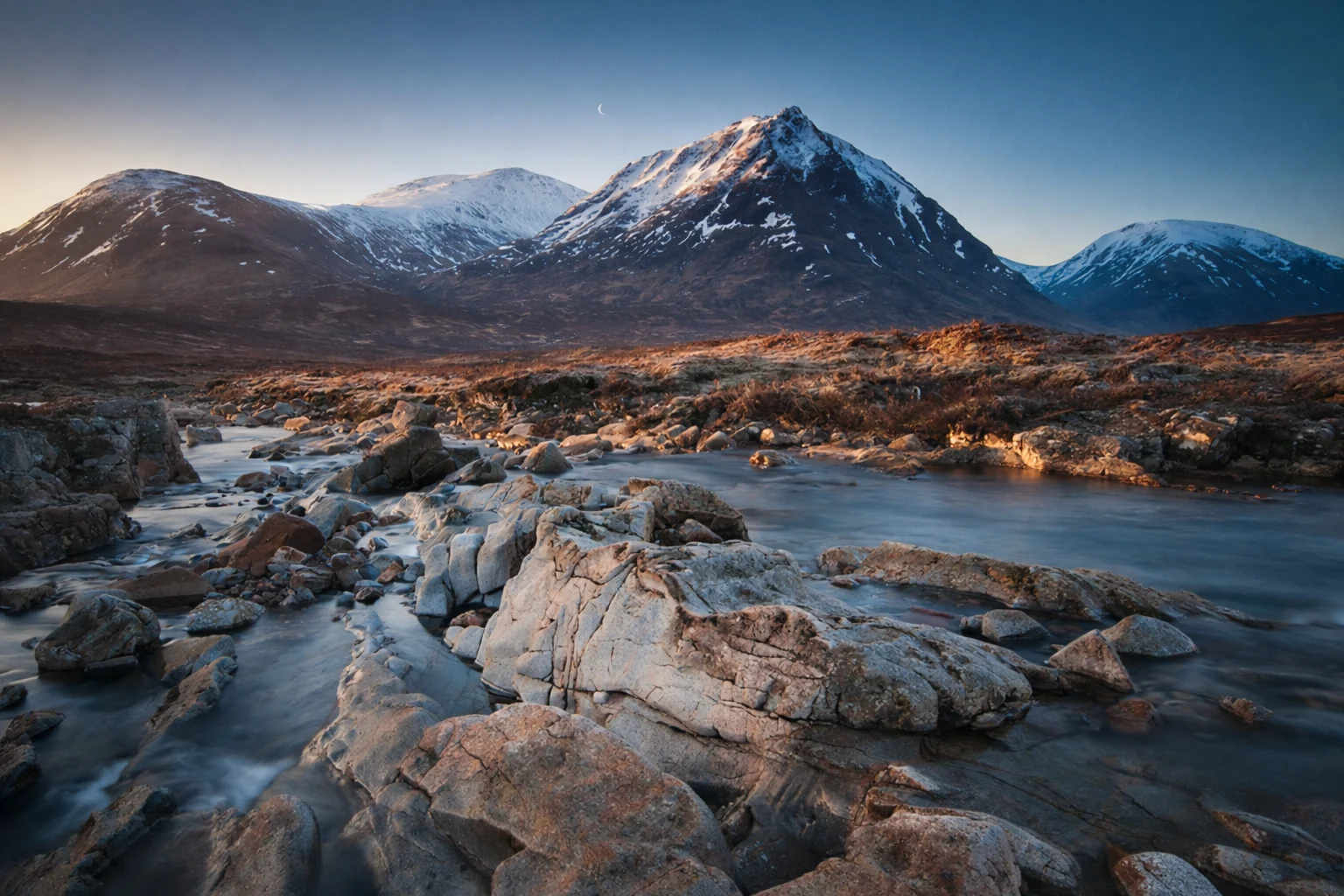
Glencoe Mountain Resort, on Rannoch Moor, runs skiing when there is snow and says there is no guarantee how long the season lasts. The A82 through Glencoe has snow gates, and Transport Scotland patrols the network from November to March. Snow and ice can close or delay the road, so if you are driving yourself, check Traffic Scotland before setting out. Some tour operators run the route in reverse or return earlier in winter.
In autumn 2026 there are also A82 roadworks on the tour route: overnight resurfacing south of Rannoch Moor until mid-October, and a lane closure with traffic lights near Urquhart Castle from 28 September to 24 December. Most of this work is at night, but expect short delays in the day. The long nights of winter also raise the chance of seeing the northern lights from the Scottish Highlands, although a sighting needs a clear sky and strong aurora activity, and on a day tour the dark hours are spent on the road back, so it is not something to plan a tour around.
Frequently Asked Questions
What is the best month to visit Glencoe and the Scottish Highlands?
For a first trip, May offers the best overall balance: Glencoe has more than 16 hours of daylight by mid-May, western Scotland is generally in its drier spring period, and midge numbers are lower than in midsummer. June has even longer days, but May already has more daylight than a full-day tour lasts.
Do Glencoe day tours run in winter?
Yes. Day tours from Edinburgh, Glasgow and Inverness are available all year, although some operators run the route in reverse in winter or return earlier. Glencoe has under 7 hours of daylight in mid-December, so part of a 12- to 13-hour tour is in the dark.
When is midge season in the Highlands?
VisitScotland puts the midge season at May to October, with peak activity in midsummer. Midges are most active at dawn and dusk and on calm, damp days. On a coach day tour with short stops they are usually a minor inconvenience; they matter more on woodland walks or long stops on calm evenings. The lowest midge risk is from November to April.
Is there snow in Glencoe?
Snow falls mainly from November to April, the Met Office says, with brief falls on high ground in October and May. The higher mountains are snow-covered far more often than the glen, which may be green, brown, frosty or snowy depending on the weather. Snow and ice can delay the A82, so check Traffic Scotland before driving in winter.
What is the rainiest time of year in the West Highlands?
October to January. At Dunstaffnage near Oban, the nearest Met Office station with full records, January averages 206 mm of rain, against 92 to 96 mm a month from April to June. Glencoe itself is wetter than the coast.
Is Glencoe busy in summer?
Yes. No one counts visitors in the glen month by month, but every series available, from airport passengers to hotel occupancy, peaks in July and August, when Scottish and English schools are on holiday. January and February are far quieter in the same series.
When is autumn colour in Glencoe?
VisitScotland says October brings peak autumn colour across Scotland, and the slopes of Glencoe turn rust and gold. NatureScot says red deer stags can be heard roaring in the rut from late September.
Sources and Methodology
Where the figures come from, and where the evidence stops
- Climate: Met Office 1991–2020 averages for Dunstaffnage (3 m, near Oban, 33 km south-west of Glencoe), the nearest station with temperature, rain and sunshine. Inland, Tulloch Bridge (249 m) has colder nights, with 12 to 14 days of air frost a month from December to February, and the same seasonal rainfall pattern. Seasonal statements come from the Met Office’s Northern Scotland climate profile. There is no Met Office station in Glencoe itself.
- Daylight: calculated for Glencoe village (56.68°N, 5.10°W) with the NOAA solar-position method, for the 15th of each month in UK clock time.
- Visitor numbers: UK Civil Aviation Authority monthly airport statistics for Edinburgh and Inverness (2025); VisitScotland’s Scottish Accommodation Occupancy Survey 2024 (Scotland-wide); the Highland Council’s report on the Storr (2023, read from a chart).
- Seasons and nature: VisitScotland on midges and autumn colour; NatureScot on heather and the red deer rut; the Met Office on snow.
- Opening hours: National Trust for Scotland (Glencoe Visitor Centre), Historic Environment Scotland (Urquhart Castle), Loch Ness by Jacobite and Cruise Loch Ness, and the tour operators’ own pages, all read on 24 September 2026. Roadworks: Traffic Scotland, read the same day; recheck before 24 December 2026.
- Tour price and reviews: the GetYourGuide listing, read on 24 September 2026. Prices change; the booking page is always current.
Where the evidence stops. Climate averages are 30-year normals, not a forecast. A monthly rain total does not tell you how many hours it rained or whether your afternoon will be dry. Dunstaffnage is on the coast; Glencoe is wetter and the mountains colder. The visitor series are a proxy for demand in the Scottish Highlands, and none of them counts people at Glencoe or Loch Ness. There is no monthly price series for day tours, so this page makes no claim about the cheapest month. Snow, cloud and midges vary from day to day, which is what the date checker is for.
More on Planning Your Trip
Glencoe and Loch Ness in a Day
The full-day tour from Edinburgh runs all year, with a cruise, castle or distillery option chosen when you book.