Close your eyes and picture Scotland. Chances are, you're imagining misty mountains, rugged warriors in kilts, and ancient family tartans that have been passed down for a thousand years. Maybe you're hearing bagpipes. Maybe Mel Gibson is shouting about freedom.
It's a powerful image, and a lot of it is wrong.
That doesn't make it any less fascinating, though. The real story of Scotland's clans and tartans is actually far more interesting than the Hollywood version. It's a story of survival, clever politics, family loyalty, Victorian marketing genius, and one very bold king squeezing himself into a kilt. Let's unravel it together.
What Were Scottish Clans, Really?
Forget what you've seen in movies. A Scottish clan wasn't a tribe of wild warriors living in caves. The word "clan" comes from the Gaelic word clann, which simply means "children" or "family." At its heart, a clan was an extended family network — a community of people who shared (or claimed to share) a common ancestor, led by a chief they trusted and followed.
Think of it like a large, loosely connected family with a respected head of household — except that "household" could span entire valleys, islands, and mountain ranges across the Scottish Highlands.
The chief wasn't just a military leader. He was a landlord, a judge, a protector, and sometimes even a father figure. In return for his leadership and protection, clan members owed him loyalty, military service, and a share of their crops or cattle. It was a two-way deal: the chief looked after his people, and his people supported him.
But here's something most people don't realise: you didn't have to be related by blood to be part of a clan. Many clan members were tenants, allies, or even former rivals who had been absorbed into the group over time. If you lived on the chief's land and accepted his authority, you were part of the clan, and you often took his surname too. That's why so many Scottish surnames are actually clan names.
Other Experiences You Might Enjoy
Building a longer trip around Loch Ness? Add a day in Glencoe, a detour to Eilean Donan Castle on the way to the Isle of Skye, or a stop at the Glenfinnan Viaduct and a ride on the Jacobite steam train. Day-trippers based in Edinburgh or Glasgow can fold in Loch Lomond along the way. The suggestions below are matched automatically to these Scottish Highlands destinations and experiences.
How Did Clans Start?
The clan system didn't appear overnight. It evolved gradually over centuries, shaped by the unique geography and politics of the Scottish Highlands.
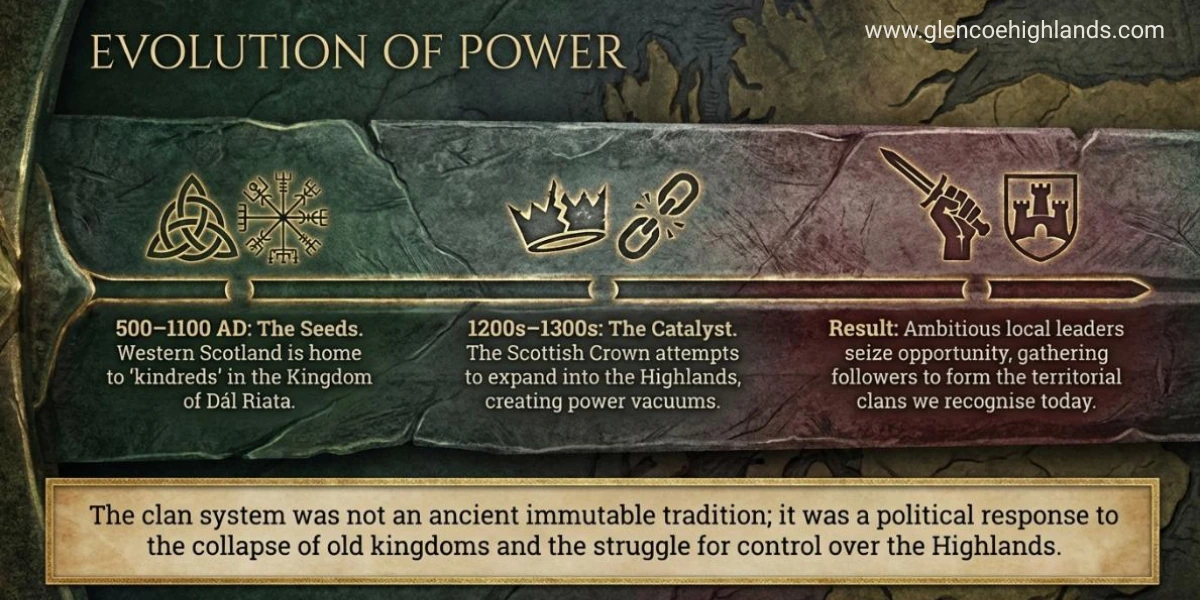
The roots go back to early medieval times (around 500–1100 AD), when western Scotland was home to small kingdoms and kin groups. In the ancient kingdom of Dál Riata (roughly modern-day Argyll), powerful family groups called "kindreds" controlled territories like Kintyre, Lorne, and Islay. These weren't quite clans in the way we'd recognise them later, but they were the seeds.
The clans we'd actually recognise — with named chiefs, loyal followers, and territorial power — really took shape in the 1200s and 1300s. This wasn't because of some ancient tradition springing to life. It happened because of politics and power vacuums.
When the Scottish crown expanded into the Highlands and tried to control formerly independent regions, it created opportunities for ambitious local leaders. These strongmen gathered followers — not just blood relatives, but tenants, allies, and anyone willing to take on their name in exchange for protection. In a remote landscape where the king's law barely reached, the clan chief was the law.
In short, clans started because they were practical. In the wild, mountainous Highlands, where central government was weak and distances were vast, organising yourself around a powerful local leader was simply the smartest way to survive.
Where Did Clans Live?
The classic clan system is most closely associated with the Scottish Highlands and Islands — the rugged, mountainous region stretching from the Great Glen northward and westward, plus the scattered islands of the Hebrides.
This makes sense when you think about it. The Highlands were remote, hard to govern from Edinburgh, and full of natural barriers like mountains, lochs, and sea channels. In this landscape, power was local. The chief who controlled the glen, the island, or the coastal peninsula was the real authority.
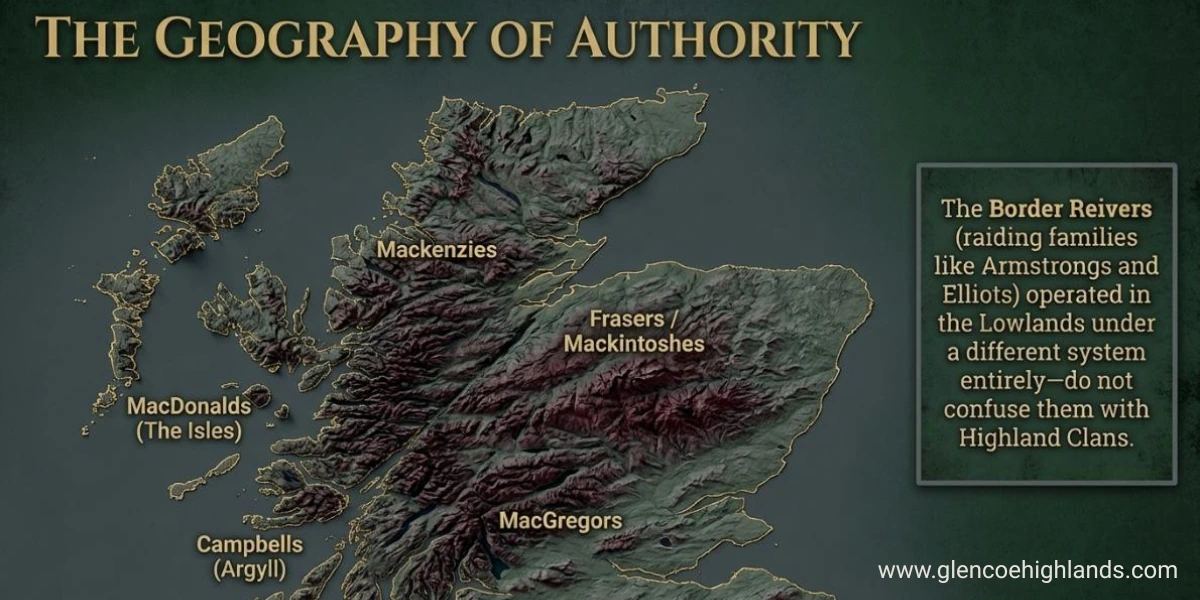
Different clans dominated different regions:
- The MacDonalds were powerful across the western seaboard and the Isles
- The Campbells dominated Argyll and much of the western Highlands
- The Mackenzies held sway in the north-west
- The Frasers and Mackintoshes were prominent around Inverness
- The MacGregors lived (and fought) in the lands around Loch Lomond and the Trossachs
It's worth noting that the Lowlands had their own kin-based groups too — particularly the famous Border Reivers (raiding families like the Armstrongs, Elliots, and Kerrs) who terrorised the English-Scottish borderlands. But these operated under a different system and shouldn't be confused with Highland clanship.
Why Did Clans Fight Each Other?
Here's where the movies get closest to the truth, but also oversimplify things badly. Yes, clans fought. A lot. But their battles weren't (usually) about "ancient hatreds" or some mystical blood feud stretching back centuries.
Clan conflict was usually about very practical things:
- Land and territory — the most valuable resource in an agricultural society
- Cattle raiding — stealing your neighbour's cows was practically a Highland sport, and a young warrior's rite of passage
- Political alliances — clans often got dragged into larger conflicts between the Scottish crown and rival factions
- Succession disputes — fights over who should be the next chief could tear a clan apart
- Honour and status — insults, real or perceived, could escalate quickly in a culture where reputation was everything
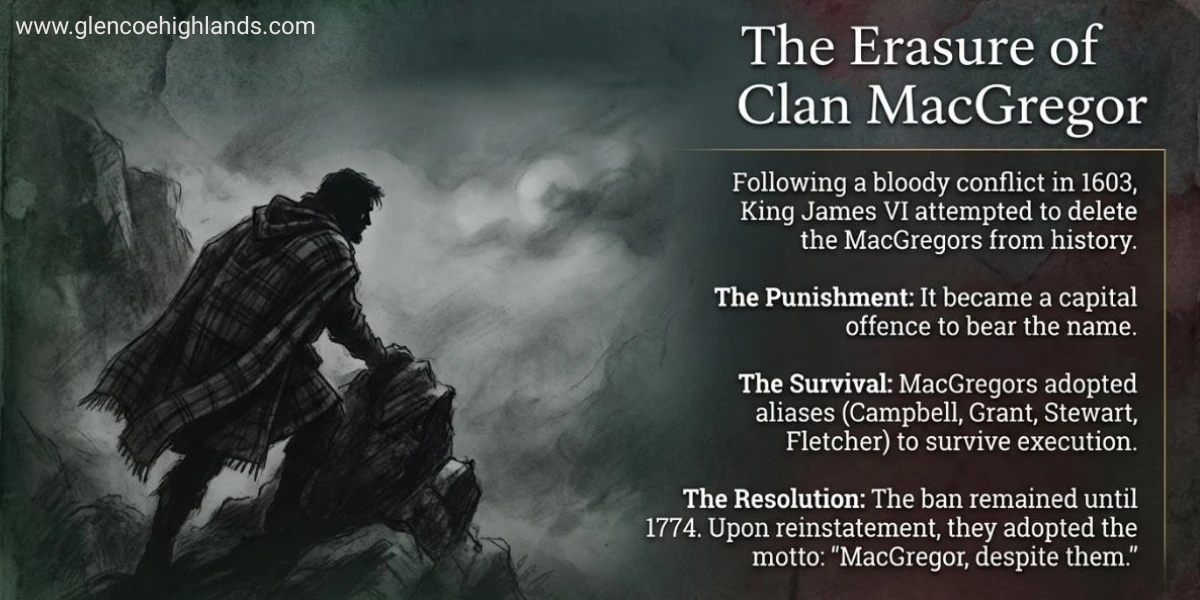
One of the most dramatic examples is the Clan Gregor (MacGregors). After a bloody conflict with a rival clan in 1603, the government didn't just punish them, it tried to erase them entirely. King James VI made it a capital offence to even use the name MacGregor. Members were hunted, and those who refused to abandon their name could be executed.
To survive, MacGregors adopted aliases — Campbell, Grant, Stewart, even Peters or Fletcher. The ban wasn't lifted until 1774, after which many triumphantly reclaimed their name with the defiant motto: "MacGregor, despite them."
The Great Tartan Myth: How Tartans Became "Clan Badges"
This might be the biggest surprise in the whole story. Sit down for this one.
Clan tartans — those specific patterns "belonging" to each family — are mostly a Victorian invention.
Yes, really.
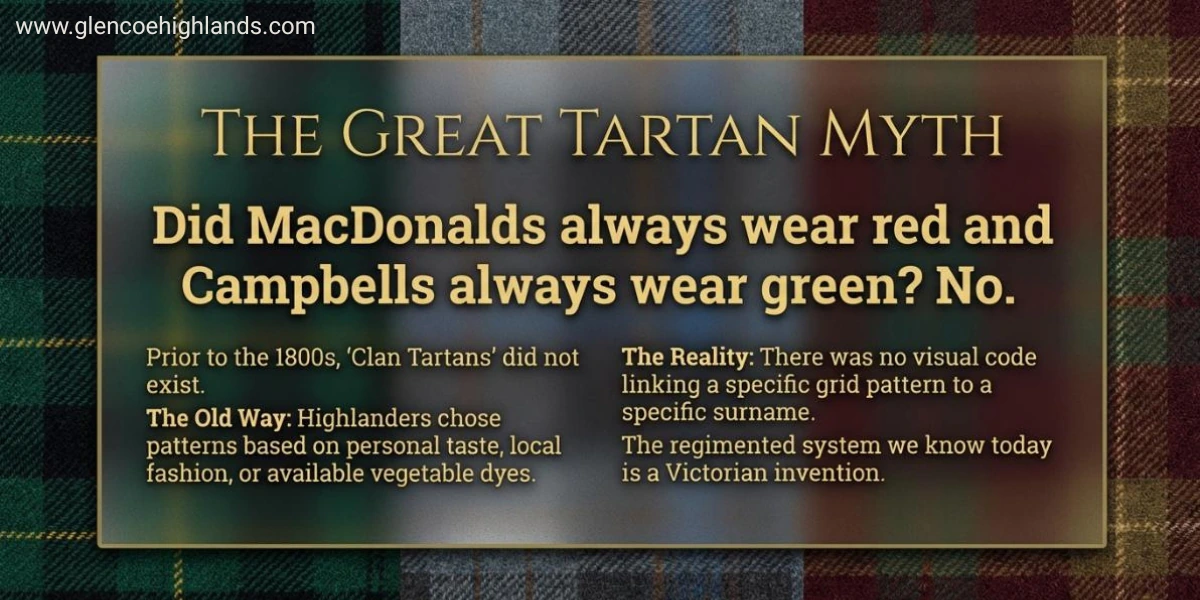
Highlanders did wear tartan, the distinctive criss-cross woven fabric has been used in Scotland for centuries. But before the 1800s, people chose their tartan based on personal taste, local fashion, or simply whatever dyes were available from plants in their region. There was no rule that said "MacDonalds wear this pattern" and "Campbells wear that one."
So How Did "Clan Tartans" Happen?
The transformation happened through a perfect storm of commerce, literary romance, and one spectacular piece of royal theatre:
1. The Weaving Business
A company called William Wilson & Son of Bannockburn became Scotland's dominant tartan manufacturer in the late 1700s. In their 1819 pattern book, they started assigning clan names to previously numbered patterns, essentially creating "clan tartans" to sell more fabric. It was a marketing move, pure and simple.
2. The Sobieski Stuart Forgery
In 1842, two brothers claiming (fraudulently) to be descendants of the Royal House of Stuart published a book called Vestiarium Scoticum. They said it was an ancient manuscript listing each clan's "true" tartan. It was a brilliant forgery, and many families accepted it as gospel.
3. The King's Jaunt (1822)
This was the big one. When King George IV visited Edinburgh in 1822 — the first reigning monarch to visit Scotland in 171 years — the novelist Sir Walter Scott orchestrated the entire event as a spectacular Highland pageant. Suddenly, every clan chief was expected to appear in a specific tartan (many invented on the spot by tailors). Lowland gentlemen who had previously looked down on Highlanders as "barbarians" were pressured to dress up in full Highland costume. And the king himself wore a kilt — in a profound irony, since tartan had been banned as a symbol of rebellion just decades earlier.
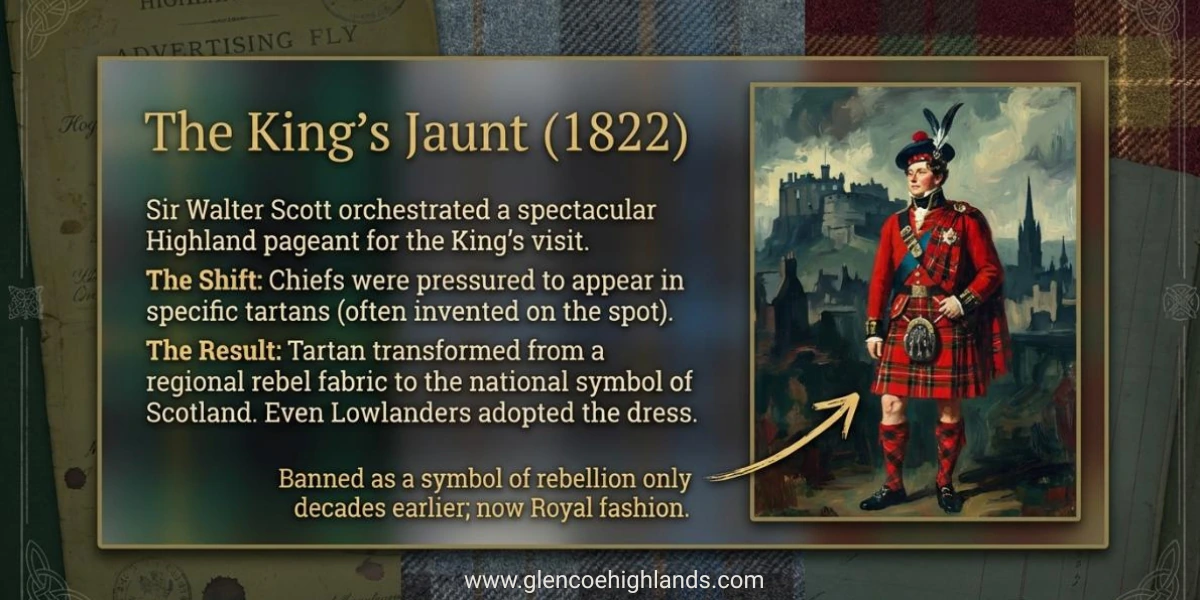
That 21-day visit permanently changed Scotland's global image. Almost overnight, tartan went from being a regional fabric associated with Highland rebels to the national symbol of all Scotland.
Bonus Surprise: Tartan Is Way Older Than Scotland
Here's a twist even most Scots don't know about: the oldest surviving tartan-patterned cloth wasn't found in Scotland at all. It was found in China.
In the Tarim Basin of Xinjiang, archaeologists discovered naturally preserved mummies dating back to approximately 2100 BC — over 4,000 years ago, wearing vibrant tartan-like fabrics. The most famous, the "Chärchän Man" (c. 1000 BC), was buried in colourful tartan leggings.
Similar ancient samples have been found in the Hallstatt salt mines of Austria, dating to around 1200 BC.
This doesn't mean these ancient peoples had anything to do with Scotland. It simply means the tartan weaving technique — that distinctive criss-cross pattern — was a widespread, sophisticated textile technology used by cultures across the ancient world, long before anyone in Scotland picked it up.
What Braveheart Got Wrong (Sorry, Mel)
We know, we know, it's an epic film. And Mel Gibson's Braveheart (1995) did more to put Scotland on the tourist map than almost anything else. But as a history lesson, it's… creative.
Here are the big problems:
🎬 Kilts and Tartans in the 1290s?
William Wallace fought in the late 1200s. The belted plaid and Highland kilt tradition belong to a much later period, at least the 1500s and 1600s. Wallace and his followers would have worn clothing typical of medieval Europe: tunics, leggings, and cloaks. Not kilts.
🎬 "Clan Warriors" in the Wars of Independence?
The film presents Wallace's army as Highland clan warriors. But the clan system as we know it hadn't fully developed yet in Wallace's time. His rising was part of a much broader coalition of nobles, knights, and regional fighters — not a "clan army" in the later sense.
🎬 Face Paint?
That iconic blue warpaint? It's inspired by descriptions of ancient Picts who lived over a thousand years before Wallace. By the 1290s, nobody was painting their face blue before battle.
None of this means Braveheart is a bad film, it's just not a documentary. The real William Wallace was a fascinating figure: a knight from the lesser nobility who led a stunning uprising against English occupation. But the "Highland warrior in a kilt" image is a romantic invention layered onto his story centuries later.
The Beginning of the End: Culloden and After
The clan system didn't die in a single dramatic moment, but if you had to pick a turning point, it would be the aftermath of the Battle of Culloden in 1746.
The Jacobite risings — a series of attempts to restore the Stuart monarchy to the British throne — are often simplified as "Highland clans vs. the English." The reality was far messier. Not all Jacobites were Highlanders, not all Highlanders were Jacobites, and the conflict was more of a complex civil war than a neat national showdown.
But after the Jacobite defeat at Culloden, the British government decided to dismantle the Highland way of life. The Heritable Jurisdictions Act of 1746 stripped clan chiefs of their legal powers. They could no longer act as judges, tax collectors, or military commanders in their territories. Restrictions were placed on carrying weapons and wearing Highland dress (including tartan) for civilian men and boys, though soldiers in the British army were notably exempt.
Over the following decades, economic changes accelerated the transformation. Many chiefs reinvented themselves as commercial landlords, sometimes evicting their own people to make way for more profitable sheep farming, the infamous Highland Clearances. The old relationship between chief and clan member, based on mutual obligation and loyalty, was replaced by cold economics.
The clan system didn't "end" on a specific date. It was slowly transformed from a living system of governance, protection, and community into something very different — the heritage and identity movement we know today.
Test Your Clan Knowledge
Now that you've discovered the real story behind Scotland's clans and the truth about those "ancient" tartans, why not put your knowledge to the test?
Take the Scottish Clans QuizClans Today: Heritage, Identity, and a Living Legacy
Modern clans are a very different thing from their medieval originals. Today, clans function mainly as heritage and civic identity communities. Clan chiefs are recognised by the Court of the Lord Lyon (Scotland's heraldic authority), and organisations like the Standing Council of Scottish Chiefs represent clan interests.
Clan gatherings, highland games, and tartan celebrations attract millions of people worldwide — particularly from the Scottish diaspora in North America, Australia, and New Zealand. For many, claiming a clan connection is a meaningful way to connect with their roots.
And while the "ancient clan tartan" may be largely a Victorian invention, that doesn't make it meaningless. As one historian put it: heritage is a "vessel of meaning" that we fill according to the needs of our time. If wearing your family tartan gives you a sense of belonging and pride, does it really matter that the pattern was designed by a Bannockburn weaver in 1819 rather than by a medieval chief?
Sometimes the most powerful traditions are the ones we choose — not the ones we inherit.
Frequently Asked Questions
This depends on how you define "oldest." If you mean the earliest kin groups in Scotland, then the ancient kindreds of Dál Riata (modern Argyll) — territorial groups like the Cenél nGabráin and Cenél Loairn — date back to the early medieval period (c. 500–800 AD). But these weren't "clans" in the later sense.
If you mean the earliest recognisable Highland clan with a chief and followers, the Clan Donald (MacDonald) lordship is documented as a major force by the 1300s. Many clans claim ancient origins, but verifying continuous existence over centuries is extremely difficult. In truth, there's no single "oldest clan" — it depends on which definition you use.
The most common surname in Scotland overall is actually Smith — which isn't typically thought of as a "clan name." Among surnames strongly associated with clans, the most common in modern civil records include Robertson, Stewart, Campbell, and Macdonald. But it's important to note that having a clan surname today doesn't necessarily mean you have a historical connection to that clan.
No. This is one of the biggest myths in Scottish history. Before the early 1800s, Highlanders wore tartans based on personal preference, local availability of dyes, or regional fashion — not clan affiliation. The idea of specific "clan tartans" was largely created by commercial weavers, romantic novelists, and Victorian pageantry. Most of the tartan patterns we associate with specific clans today were assigned or invented in the 19th century.
William Wallace was a member of the lesser nobility and the Wallace family. There is a modern identification of "Clan Wallace" as a Lowland clan, but this identity framework was developed much later. In Wallace's own time (the 1290s), the Highland clan system as we know it hadn't fully formed, so it's anachronistic to call him a "clan warrior." He was a medieval knight and patriot, not a kilted Highland chieftain.
It didn't end on a single day — it was gradually dismantled and transformed over about a century. The key blows were:
- The Heritable Jurisdictions Act (1746) stripped chiefs of their legal powers after the Jacobite defeat at Culloden
- Restrictions on Highland dress and weapons targeted the symbols and tools of clan military identity
- The Highland Clearances (late 1700s–1800s) saw many chiefs reinvent themselves as commercial landlords, evicting their own people
- Broader economic and social modernisation made the old chief-and-follower system increasingly irrelevant
The clans didn't vanish — they transformed into the heritage identity communities we know today.
Several clans have strong connections to the Norse world. The Outer Hebrides and much of Scotland's north-west coast were part of a Norse empire for centuries, and later clan structures in these regions grew out of that Norse-Gaelic cultural mix.
The most prominent example is Clan Donald (MacDonald) — descended from Somerled, a 12th-century warlord who operated in a Norse-Gaelic maritime world. In the far north, Clan Gunn of Caithness has documented connections to Norse-influenced society. Clans like MacLeod and MacAulay also have Norse personal-name origins ("Ljótr" and "Óláfr" respectively).
That said, "Viking roots" is sometimes used as romantic branding, so these claims should always be understood in their proper historical context rather than as proof of "Viking blood."
"Feared" depends on who you ask. But if we measure "feared" by state response, Clan Gregor (MacGregor) stands out dramatically. The Scottish Parliament passed laws abolishing the very name MacGregor, making it punishable by death — an extraordinary level of state hostility. On Scotland's southern border, the raiding families known as Border Reivers (Armstrongs, Elliots, and others) were feared locally in a different way, though they operated under a completely different system from Highland clans.
He almost certainly didn't wear one — at least not in the way we imagine. In the late 1200s, there's no evidence that Wallace or his followers wore clan-assigned tartans. The kilt and belted plaid tradition belongs to a much later period. Wallace would have dressed like a typical medieval European nobleman or knight. The image of Wallace in a kilt is a romantic invention, popularised by much later art and film.